Having visited Inis Mór and Inis Oírr, it was only right that I should make a trip to the remaining one of the three Aran Islands. Inis Meáin (or Inismaan) is the least visited of the three islands, making it a very different experience from the other two.
Getting Around 🚶♂️
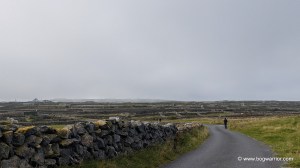
Straight away, you know things will be a little different here. For starters, there is no direct ferry – the boat which dropped us off was en route to Inis Mór and would make the same trip in reverse later on. Although the ferry was busy enough for mid-September, only a handful of people disembarked at the pier on Inis Meáin. And then…nothing! The piers on the other two islands are at the heart of their main villages and visitors are greeted straight away with the trappings of modern-day tourism. Bike hire shops, locals offering guided tours by horse or minibus, food trucks, signs for nearby shops and businesses. Here, the pier is 3km away from the main village, which is located inland. In a way, this is symbolic of the way this island works. You have to work that little bit harder to to get around but it is definitely worth it. There were no bikes to hire, perhaps the summer season was over, so walking was the only game in town.

As with the two other islands, the signposting is a bit sketchy. There are some signs for loop walks but really, your life will be made easier if you have a good printed map or decent map app on your phone. I used Google Maps and found it very useful, both for finding my way around and for calculating how long it would take to walk to the various highlights. Being on Shank’s mare meant a few places on the “to visit” list were snipped out. Still, there was plenty to see on the day. More than anything, a day out on this wonderful island proved to be a wonderful way to get away from it all and to clear my head.
Clochán
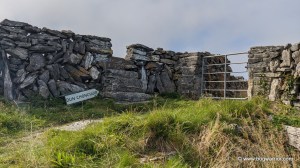
A Clochán is a dry stone hut which is built from stone and has a corbelled roof. Many of them were monastic huts and there are some dramatic examples around. The best known of these are probably the beehive huts on Skellig Michael off the south coast. Star Wars fans will recognise them from The Last Jedi. Like the other clocháns which are found in Ireland, it isn’t known when this one was built but it is many centuries old. Unfortunately, this one isn’t in good condition but the roof is still intact. As well as the little front entrance, it has a side window. You can still crawl into the hut but I chose not to – the photos online were enough to satisfy my curiosity! There is a small, very old graveyard overlooking the clochán.

Dun Chonchúir
Because I was on foot, I didn’t get more than a cursory look at the outer edges of this extensive and ancient fort. I was also conscious of how much time I’d spent going to and from Dún Aongasa on Inis Mór, only to conclude that it looked far more impressive from the air… It is the largest of the stone forts on the Aran Islands and is built on the highest point of Inis Meáin. There are a few small clocháns in its inner keep which were repaired in the 19th century.

Séipéal Mhuire gan Smál
I have to admit that modern-day churches don’t do a lot for me, especially the 19th century gothic revival ones. However, the 1930s church here is lovely and worth a visit. Most of the stained glass windows are from the Harry Clarke Studio1 and they’re exquisite. The altar was crafted by James Pearse, the sculptor father of Irish revolutionaries Padraig and Willie Pearse. James died in 1900 (i.e. long before this church was built) so I assume this altar had been in an older island church before this. (Please let me know)

Teampal na Seacht Mac Rí and St. Kennerg’s Bed
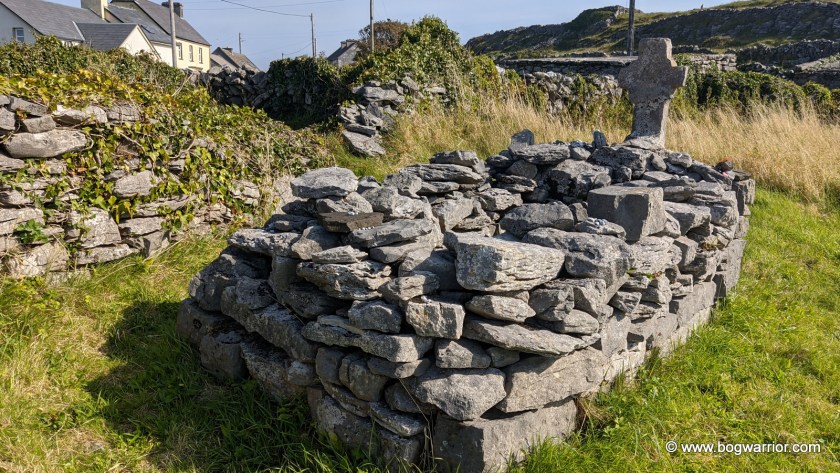
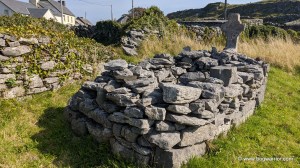
On the way into the village, I walked past the remains of Teampall na Seacht Rí and St. Kennerg’s Bed or grave which is right beside it. There isn’t much left to see of the church but the grave beside it is more striking. Kennerg was the daughter of the King of Leinster and was highly venerated at one stage.
Lunch
Armies and occasional bloggers don’t like to march on empty stomachs. And so, lunch was the next important milestone. Teach Ósta is the only pub on the island so being barred is not a wise move. Happily, they serve hot food and cold drinks – the chicken goujon wrap was very welcome. It was also a chance to hear the locals chattering as gaeilge because Irish is the first language here. There is a shop nearby but it was closed for lunch so I didn’t get to see what it was like. Like this pub, I believe it’s the only one on the island.

Teach Synge
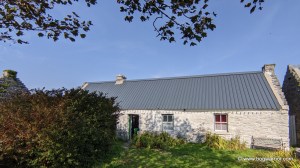
The Irish writer John Millington Synge (1871-1909) is known for his connection to the Aran Islands. His travelogue “The Aran Islands” was published in 1906. It proved to be a far less controversial work than his play “The Playboy of the Western World” (1907). When it was staged in Dublin, and later in New York, the audience rioted. Happily, visiting this old cottage where he used to holiday is a far more peaceful experience. It is still in the hands of the family who owned it in Synge’s time and it has been restored to look like it did in his time. It is hoped that the cottage can be thatched again, which will bring it back to what it looked like in Synge’s time.

Carrowlisheen/Diarmuid and Gráinne’s Bed
The Pursuit of Diarmuid and Gráinne (or “Tóraíocht Dhiarmada agus Ghráinne” if you did Leaving Cert Irish fadó fadó) is a tale from Irish mythology. Gráinne, the daughter of the High King of Ireland, decides she can’t go through with her arranged marriage to the ageing Fionn McCumhaill (Finn McCool of Giant’s Causeway fame). Diarmuid, a hunky and younger warrior catches her eye and she magically enchants him so she can avoid marrying Fionn. Before you can say “Bye Granddad”, the pair go on the run and thus the adventure begins. The story inevitably ends in tragedy but not before the couple criss-cross Ireland. There are many prehistoric sites around Ireland which bear the name “Diarmuid and Gráinne’s Bed, including this one. It is actually a megalithic wedge tomb which is looking the worse for wear now.

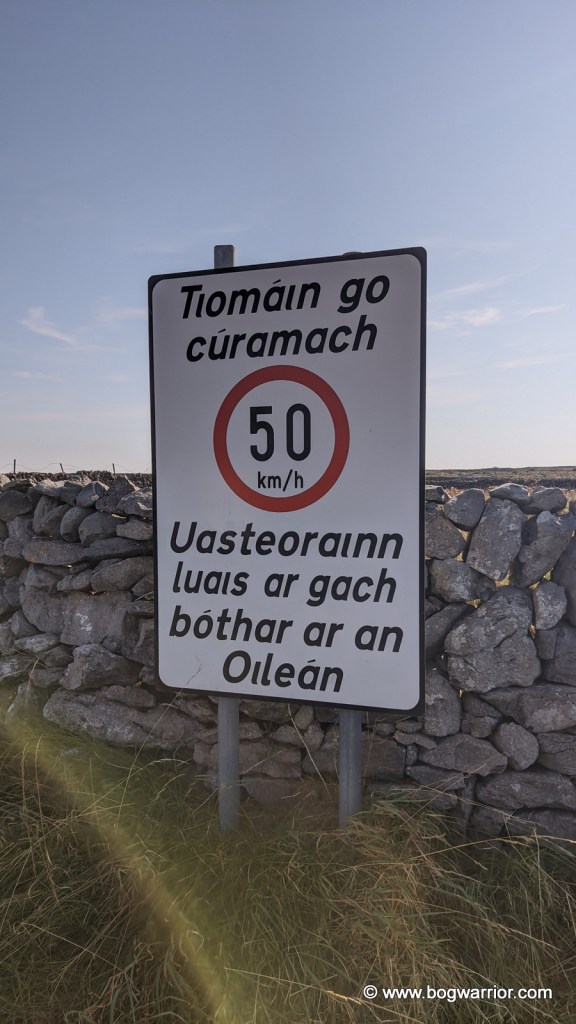
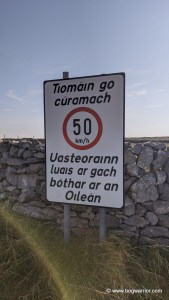
After this, I headed back to the pier to catch the ferry back to Rossaveel. The walk took me past the small airport which brings people to and from the mainland. It also gave me a chance to look at this chatty sign telling motorists to drive carefully, and that the speed limit is 50km/h on the island. After that, it was a short walk to the pier and the wait for the ferry home.
Getting There
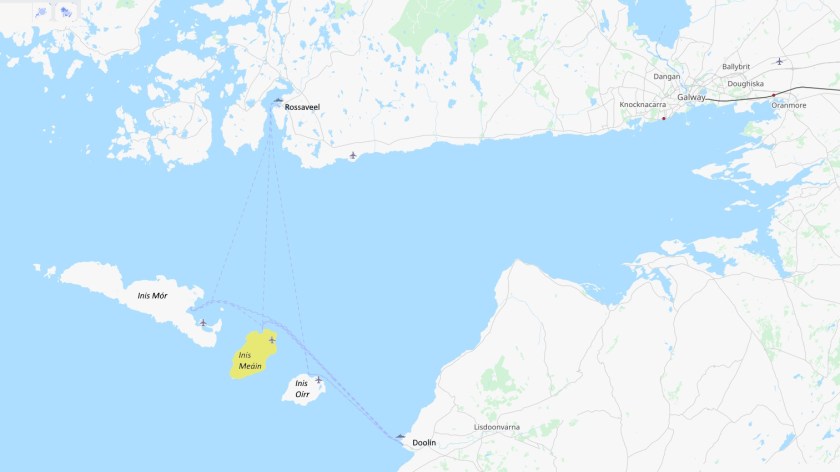
Inis Meáin is served all year round by ferries which leave from Rossaveel in Co. Galway or from Doolin, Co. Clare. Aran Islands Ferries operate out of Galway and you can either travel to Rossaveel Pier yourself, or catch their shuttle bus from Galway city centre. Two ferry companies sail from Doolin, Co. Clare – the Doolin Ferry Company and O’Brien’s Ferry. Aer Arann fly from Inverin in Galway if you fancy something different or like small planes.
As you will have gathered by now, a visit to Inis Meáin is a much more low-key affair than the other two islands. If you want the place almost entirely to yourself, go off-season and enjoy the solitude (in a nice way). Details on bike hire are sketchy but it would appear that during the summer season, bikes are available at the pier. It is possible to bring your own bike to the island but if you intend to do so, contact the ferry company first.




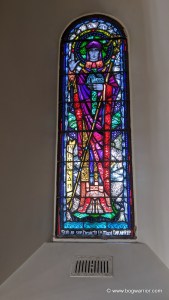


Harry Clarke(1889-1931) was a renowned Irish stained-glass window artist. After his death, the studio he founded continued to produce high-quality stained glass windows. ↩︎

 Bogwarrior.com