Temple Church

I haven’t posted here for a while so I have some catching up to do. The first new/old post I’ll do is about the Temple Church in London. When staying in the city last year, I had the good fortune to stay in a (then) very reasonably priced hotel that was right next door.
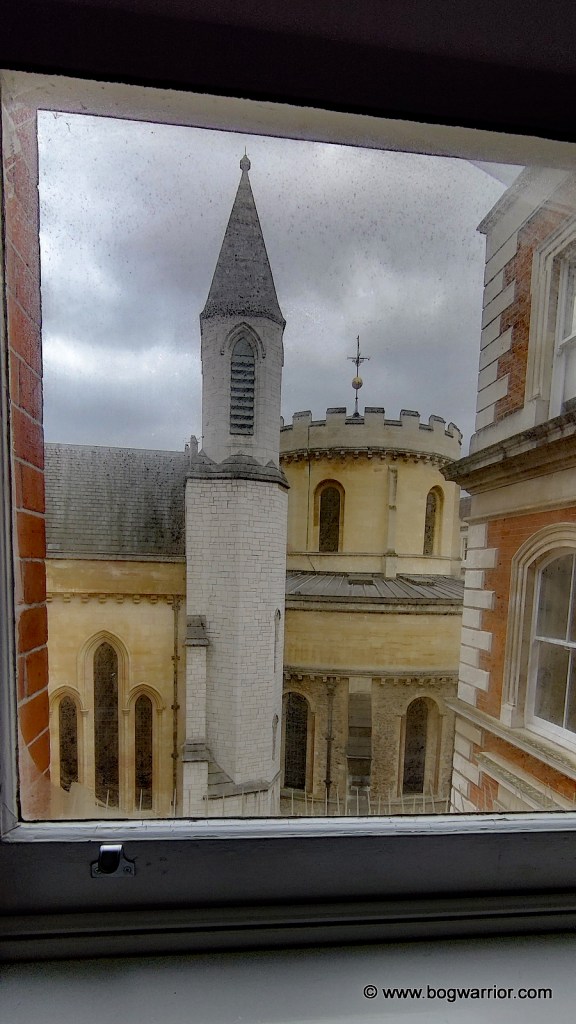
I knew very little about the church other than that it popped up in The Da Vinci Code which I read about 20 years ago, and that it had something to do with the Knights Templar. It turns out to be far more interesting than that and has connections to one of my favourite places in Ireland.
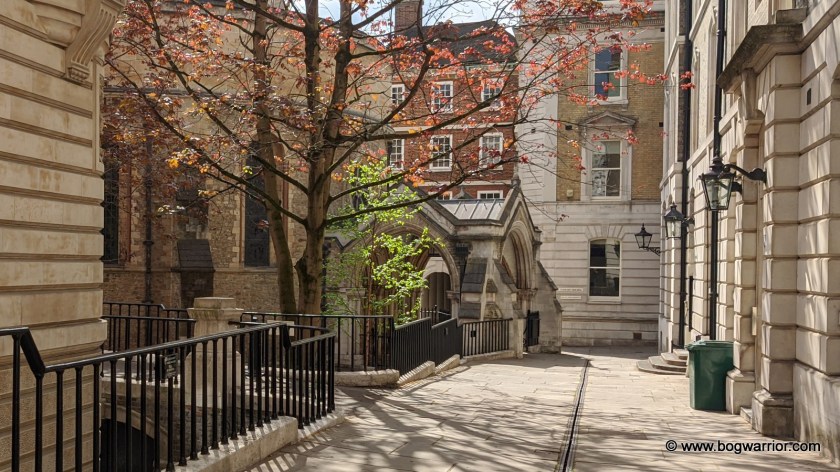
The church is at the end of a laneway, a short walk from Fleet Street. It’s nestled in the middle of London’s legal district and is surrounded by impressive looking office buildings and gardens. It’s also nice and peaceful which is always welcome in this part of the world.
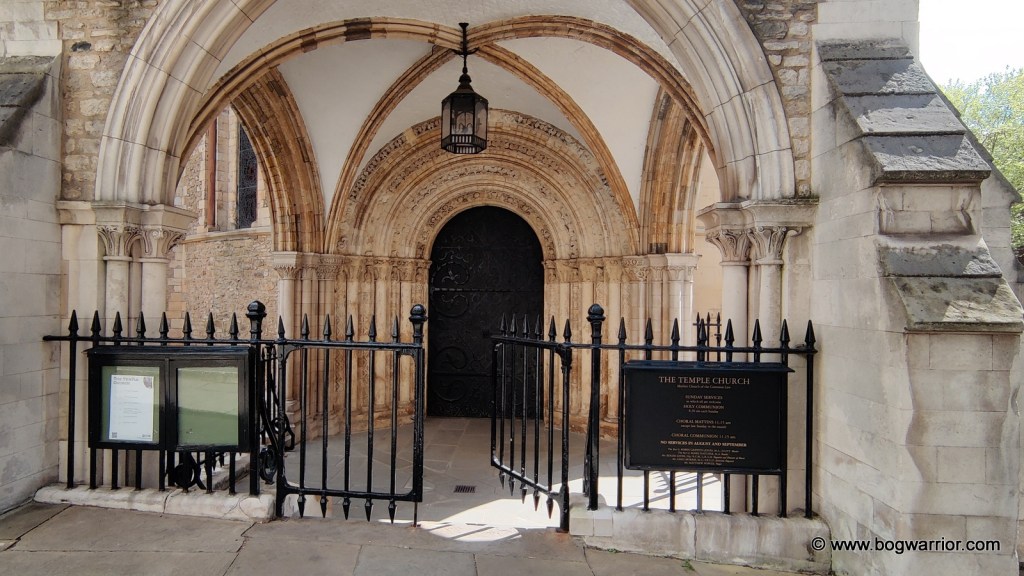
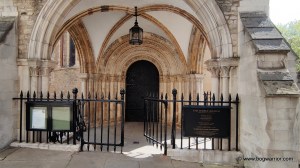
The first thing of note when you reach the church is its impressive looking West Doorway. It’s the entrance into the round part of this unusual church – more of that in a moment. Part of the decorations on the doorway include heads wearing turbans, caps and buttons. Some of these point to the interesting history of the people who built it.

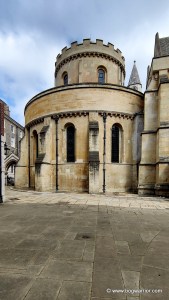
The organisation which became known as the Knights Templar was founded in 1118. One of its aims was to protect pilgrims travelling to and from Jerusalem. Although they were based in Jerusalem, in time they built a base in London. In 1162 a round church was built here, inspired by the (also round) Church of the Holy Sepulchre back in Jerusalem. A chancel was later added. The area surrounding the church became known as Temple and it became the centre of religious, political and political life in London.
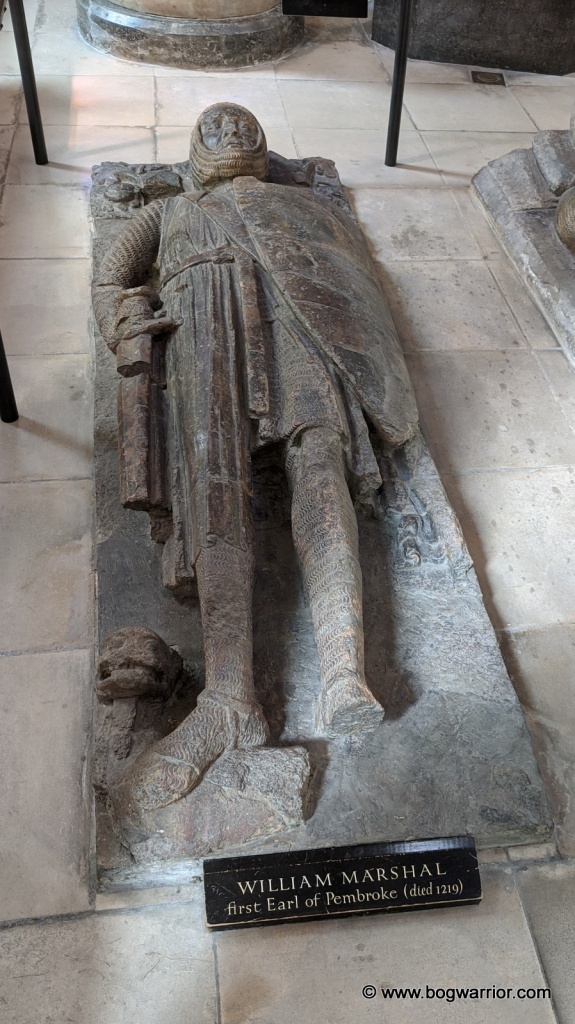
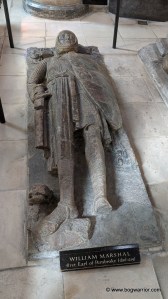
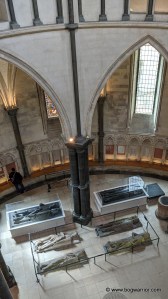
The entrance into the church is just around the corner and once inside, you’re free to roam and get a good look at the place. One of the first things to be seen in the church are 9 male effigies on the floor. The most remarkable of them all is probably that of William Marshal, the first Earl of Pembroke. He has been described as “The Best Knight that Ever Lived”. He certainly lived an eventful life and his influence extended across into Ireland. Amongst other things, he was responsible for the building of Hook Lighthouse in County Wexford 😎 William served four Kings of England and was one of the main negotiators involved in the drawing up of the Magna Carta. Indeed he was one of the signatories of it. When excavations were carried out in the church in 1842, medieval coffins were found under the floor. These are thought to have included William.
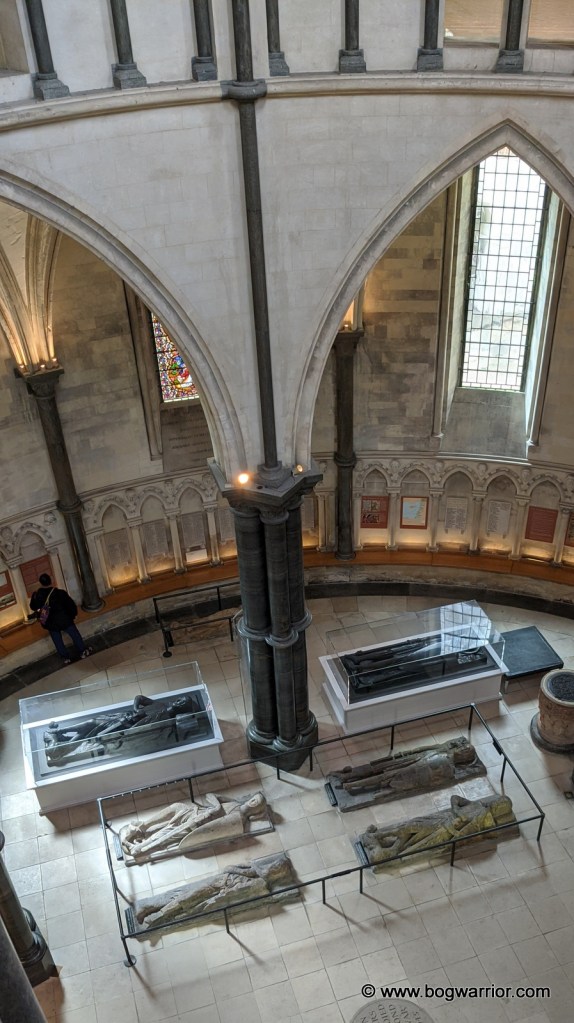
Being a tower freak, it wasn’t long before I was heading up the stairs and into the gallery. Perhaps it’s for the best that I didn’t spot any signs of the creepy tiny penitential cell that’s just off the stairs. It’s little more than the size of a broom cupboard. The story goes that an unfortunate man called Walter Bachelor was locked into the cell and left to starve to death in 1301. Is the story true? It isn’t clear but it was just one of the nefarious rumours about the Templars which were floating around at the time. On Friday 13th October 1307, King Philip IV of France and Pope Clement V moved to end the Knights Templar. King Edward II handed the church over to the order of St. John.

Like just about every other old building, the church was tweaked over the years. Sir Christopher Wren made some changes to it, but nothing like what the Victorians did. Their alterations weren’t universally popular. However, most of that was lost on the night of 10th May 1941 when German bombers dropped over 700 tons of explosives over London. Along with the huge cost to human life (an estimated 1,400 deaths and 2,000 injuries), huge swathes of the city were destroyed. The Temple Church, which had survived the Great Fire of London, was one of the casualties. It was badly damaged during the fire and it took 14 years for the church to be fully repaired.
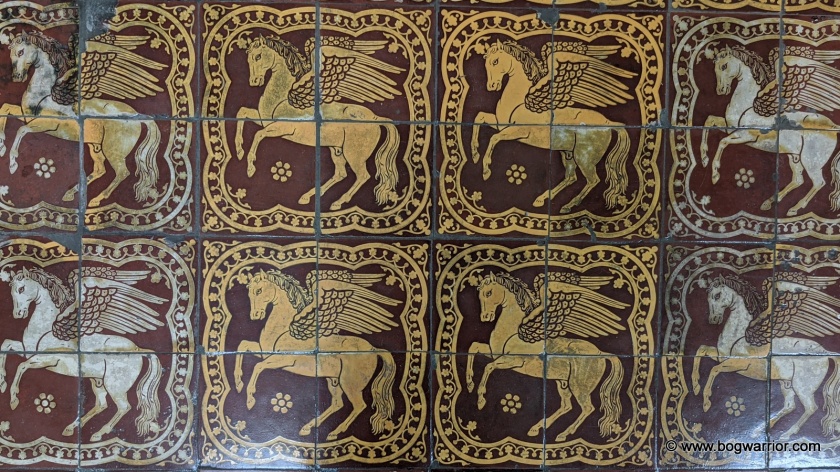
Amusingly, some of the mediaeval-inspired encaustic floor tiles which the Victorians had laid survived. These can be seen up in the gallery and they’re very striking. I also learned a new word – encaustic, encaustic…
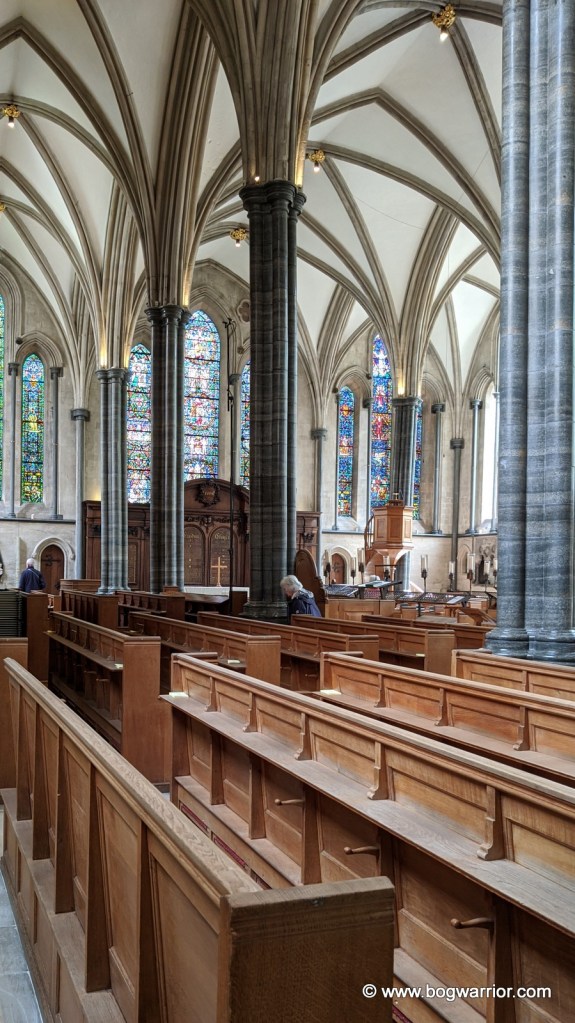
The fire had shattered the original columns in the church, so new ones were quarried for it. The originals had been noted for their crookedness, so when they were rebuilding, they continued the tradition. It goes without saying that the fire also destroyed the original church organ. Its replacement came from an unlikely source – Glen Tanar castle in Scotland. The organ had originally been built for the castle ballroom but the acoustics in the room didn’t suit it. (As an aside, I’ve never seen so many deer antlers in the one place…). And so, the organ was gifted to the church by Lord Glentanar and it was shipped down to London. Not only did it sound much much better in its new home, it gained a reputation for being a really great organ. Much of the soundtrack to Christopher Nolan’s 2014 film Interstellar was recorded on this organ, with resident organist Roger Sayer collaborating with composer Hans Zimmer. Unfortunately, I visited on a Monday so I didn’t get to hear one of the church’s Wednesday lunchtime recitals.

Churches to visit are ten-a-penny in London but this one comes highly recommended. Even though it was badly damaged during the war, the painstaking restoration of it is superb. It’s an unusual church with an interesting, sometimes dark history. And by London admission price standards, the entrance fee is pretty reasonable (£5 at the time of writing)

Gallery – click on a thumbnail to enlarge.

Robots at the London Science Museum

While in London for the Pink Floyd: Their Mortal Remains, I spotted a sign for a Robots exhibition in the nearby Science Museum. I knew nothing about the exhibition but, to paraphrase the line from Jerry Maguire, they had me at “Robots”.

Admission into the Science Museum in London is free and indeed, there’s loads to see for the price of zero pence. Some exhibitions have an entry fee and this one was one of those. Still, it was about robots, the poster was pretty cool and my head was well turned.

london2017 (128)
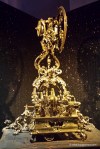
Maillardet’s automaton, taking a break from writing

As the exhibition poster says, Robots is the 500-year quest to make machines human. The first part of the exhibition had quite a few historical automatons, including a praying 16th-century monk and a draftsman from the beginning of the 19th century. There were also artificial limbs, tiny automatons which resembled insects, and even one that was part of a drinking game. I later learned that another historical automaton I’d love to have seen – the Silver Swan – had been in the exhibition until early April. Once it went back “oop north”, it was replaced by the little draftsman/writer created around 1800. When it was unearthed in 1928, nobody knew for sure who had created it and where it had been. That is, until they got the automaton working again and it started to write some pre-programmed poetry. Right at the end of its last poem, it scribbled ‘Ecrit par L’Automate de Maillardet’ (written by Maillardet’s automaton)

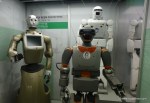
The next part of the exhibition brought us on to more recent times. It was hard not to miss the replica of “Maria”, the iconic robot from Fritz Lang’s 1927 film “Metropolis”. The original costume (which had been worn by an actress) had long since disappeared. It was also nice to get up close and personal with a T-800 from Terminator Salvation and not die horribly. There were some interesting stories attached to other robots on display in this section. Perhaps the most endearing was George the Robot, created by a young RAF officer from discarded aeroplane parts. Another British robot was beside George, this one called Eric. The original Eric the robot was created in 1928 for the Exhibition of the Society of Model Engineers, after the Duke of York cancelled his agreement to open the show. The story goes that Eric rose to his feet, bowed and gave a short speech. The robot was brought to the USA the year afterwards for a tour and vanished at some stage. The Eric on display here was a recreation of the original, funded by a Kickstarter campaign. Standing beside this pair was the Italian built Cygan. An 8 ft tall robot built in 1957 and which sold at auction for £17,500 in 2013.

london (OP3) (77)
Cygan, George and Eric

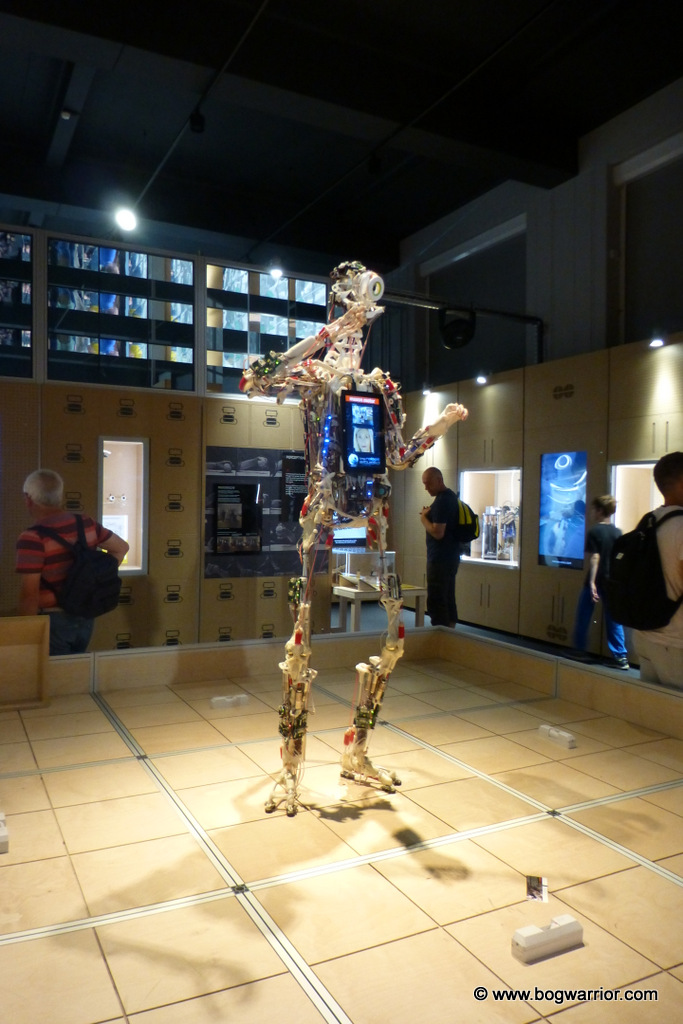
Onwards then to even more robots. It soon became clear that there have been people working in robotics for a long time, for all sorts of reasons. Some for very serious purposes such as surgery and prosthetics. Others so they knock out a few tunes on a trumpet. One interesting robot on display was an “open source” model which people can contribute to. While many of the robots were turned off and not doing anything (probably not practical to have them all operating at the time time, lest a robot apocalypse happened), seeing some in action was fascinating. The one I was particular taken with was Pepper the French robot who shakes people’s hands. Honda’s Asimo was there too, though on this occasion it wasn’t playing football, conducting an orchestra or dancing. Just think – if it had, they could’ve sold lots in the gift shop 😉 Then there was the robot which was designed to look like a real Japanese woman, a blobby one that looks like an escapee from a David Lynch film, one that acts and more than a few which track your eyes…

london2017 (134)
R.O.S.A. – Rob’s Open Source Android

Anyway, thumbs up from me for this one. It was great to see robots and automatons of all ages and to marvel at how these machines have evolved. I even brought home a cute little wooden robot of my own, which is standing on my desk as I type. I might just stop short of welcoming our robot overlords though…

Update: The exhibition is now immortalised on Google Streetview if you’re interested

To have a look at some of the photos I took, click on one of the thumbnails in the gallery below.

Smeaton’s Tower

Former offshore lighthouse, now relocated on the mainland

Lighthouses by their very nature can be tricky things to get to. So when one which was originally out at sea – perched on a dangerous windswept reef for good measure – moves to the mainland, why not? The lighthouse in question is called Smeaton’s Tower these days and has been standing in a park in Plymouth for well over a century at this stage. Originally it was known as the (third) Eddystone Lighthouse and was built on rocks which bear the same name. The name Eddystone Rocks is a little misleading because they’re not just a few random rocks 19km off the English coast but a large, dangerous reef. Needless to say, many a seagoing craft met a watery end on the reef and there is still a lighthouse out there. Even though this lighthouse is no longer serving the purpose for which it was built, it is still more than just an oversized garden ornament in a public park.

Desktop
The ill-fated first and second Eddystone lighthouses

The first lighthouse to be built on the reef was a tower designed by a man named Henry Winstanley. It was completed in 1698 but lasted just 5 years. It was swept away during the great Storm of 1703, killing 6 people including Winstanley himself who had been making modifications to the tower at the time. The second one designed by John Rudyard was completed in 1709 and remained in situ until 1755 when it was destroyed by fire. Its unfortunate 94 year old lighthouse keeper died several days later after swallowing molten lead which was falling from the burning lantern room at the top of the tower. Somewhat bizarrely, the piece of lead which killed him survives to this day.

When it came to building a third lighthouse, engineer John Smeaton was entrusted with the task.  He based the shape of it on that of an oak tree, a structure from nature which had proved to be rather good at withstanding the elements. He went back to Roman times for the type of mortar he used – hydraulic lime is what was used in the Pantheon in Rome and we know how long that has lasted. Crucially, hydraulic lime sets underwater which made it ideal for the job in hand. The lighthouse itself was built from dovetailed blocks of granite, precision cut and interlocking once they were assembled. The blocks were worked on in Plymouth, not very far from where the tower now stands. They were shipped out to sea and the lighthouse built on the reef. After over 3 years of work, the lighthouse finally came into operation in 1759.

The stump of Smeaton's tower, with its replacement lighthouse in the background
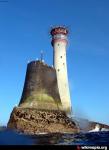
The stump of Smeaton’s Tower at sea, just in front of the lighthouse that was built to replace it

The lighthouse operated successfully out at sea until the rocks on which it was built began to succumb to erosion. It was noted in 1877 that any time large waves hit, the lighthouse would shake. A replacement lighthouse was commissioned and built close by and it survives to this day. When that was completed in 1879, Smeaton’s lighthouse fell into darkness.

Thankfully the original plan to blow up the lighthouse didn’t come to fruition. It was dismantled and brought back to Plymouth, where it was reassembled on Plymouth Hoe. In 1884 the rebuilt tower was renamed as Smeaton’s Tower in honour its creator. It has remained open to the public since then. The remnants of the lighthouse’s foundations can still be seen at sea, close to the tower which replaced it. Interestingly, the design of the replacement lighthouse wasn’t a million miles away from Smeaton’s tower. While it was still in operation, a Scottish engineer called Robert Stevenson visited it. He tweaked Smeaton’s ideas when designing the Bell Rock lighthouse off the Scottish coast. When the time came to build the 4th Eddystone lighthouse, engineer James Douglass used Stevenson’s specifications. If the Stevenson name sounds familiar, it’s probably because his grandson Robert Louis Stevenson wrote Treasure Island. The Stevensons were something of a lighthouse building dynasty and there have been books and documentaries made about them.

What’s inside?

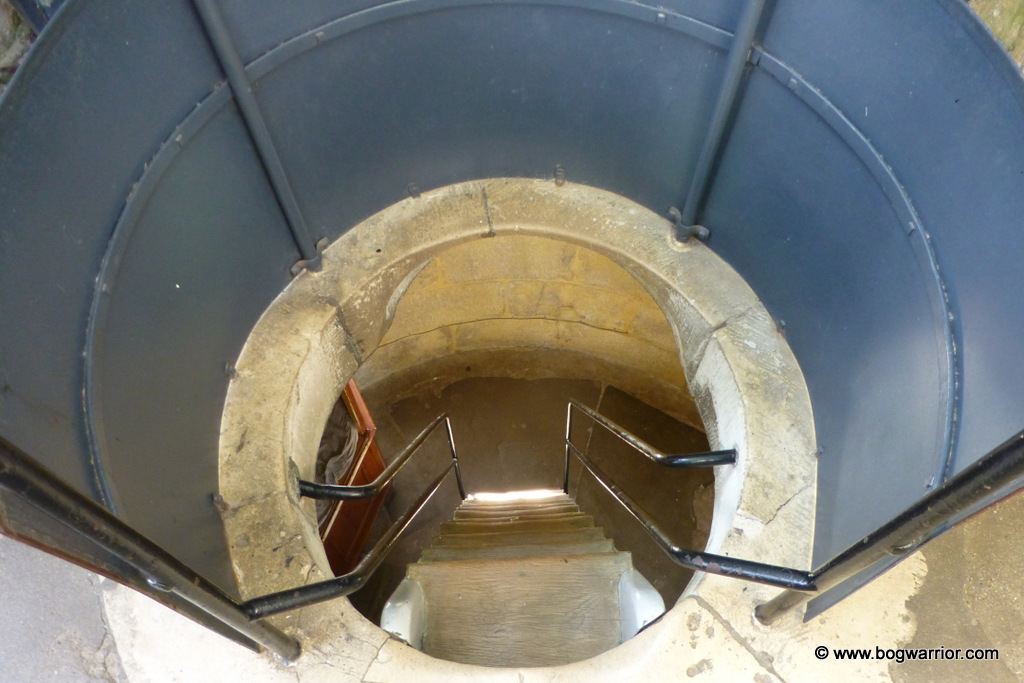
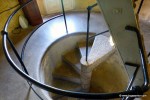
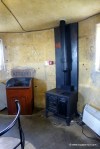
The bottom part of the tower isn’t original, of course, and has some spiral steps up to the first floor. After that though, it’s all ladders. Unlike the two other lighthouses I’ve been in which had spiral staircases along the walls, this one has floors with the same shape as Polo Mints. The different rooms in the tower are furnished with a mixture of genuine and replica furniture. There is a table which was in the actual lighthouse. Perhaps the most startling piece of furniture in the place was the bed. Living on an off-shore lighthouse was not the job for you if you were a tall person who didn’t like sleeping in cupboards.

P1010737
This, believe it or not, is a bed!

One of the notices on the wall reminds visitors that this is an 18th-century building that was designed for 3 people. Looking around the building, it’s hard not to wonder how tough life must have been for the 3 people living and working there at any time. Cramped is one word to describe the conditions. On the other hand, these guys were probably the nimblest ladder climbers around.

Looking downstairs into the bedroom

At the top of the lighthouse is the lantern room, complete with a replica of the candle holder which would’ve been there at the start. These days it offers a nice view over Plymouth and out to sea. On a good day it is possible to see out as far as the Eddystone rocks and where the story began. Plymouth itself was bombed extensively during World War II, destroying a lot of the city. It’s a miracle this wonderful building didn’t bite the dust too.

The lantern room at the top of the lighthouse

Date of visit: 5th October 2013

Click on a thumbnail to launch the gallery