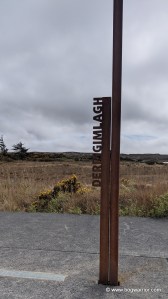
Derrigimlagh is a large expanse of blanket bog, halfway between Clifden and Ballyconneely in County Galway. Perhaps because of its location so close to the Atlantic coast, it has played host to two significant events in 20th-century history. One by accident, the other by design.
Marconi’s Wireless Station (1907)
On 12th December 1901, the world’s first Transatlantic wireless message was sent from Poldhu, Cornwall to an abandoned hospital in St. John’s, Newfoundland. The man receiving the message was the person who had created the technology behind it – one Guglielmo Marconi. After this early success, Marconi began the search for a site more suitable for a commercial operation. He finally settled on Derrigimlagh Bog which was 7km from Clifden, Co. Galway in Ireland. There were several reasons for choosing Derrigimlagh. It was close to the Atlantic Ocean on Ireland’s west coast, there was no shortage of land to build what was needed and there were ample natural resources onsite. The peat bog and the lake would supply enough fuel and water to keep everything running smoothly. The radio station began operating in 1907, transmitting messages to its sister station 3,000km away in Glace Bay, Nova Scotia.

The radio station at Derrigimlagh was quite an extensive complex. The antenna system stretched out for more than half a kilometre and consisted of 8 masts, each 6m high. A power station was built onsite with six steam-powered generators in the building – three were always in operation, with the other three as backup. A huge condenser building (106m x 23m) was built to store the energy that had been generated and to supply enough “oomph” to get those messages across the Atlantic. (I hope my old science teacher isn’t reading this thoroughly unscientific explanation). Several other buildings were constructed onsite, including housing for workers and a social club. The station did what it said on the tin, and operated successfully for a number of years.

As the technology improved, Derrigimlagh was superseded by a more powerful station at Caernarfon in Wales. In July 1922 it was attacked by Republican forces during the War of Independence and some of the buildings were damaged. That proved to be the death knell for the station. It was closed and the contents sold off.
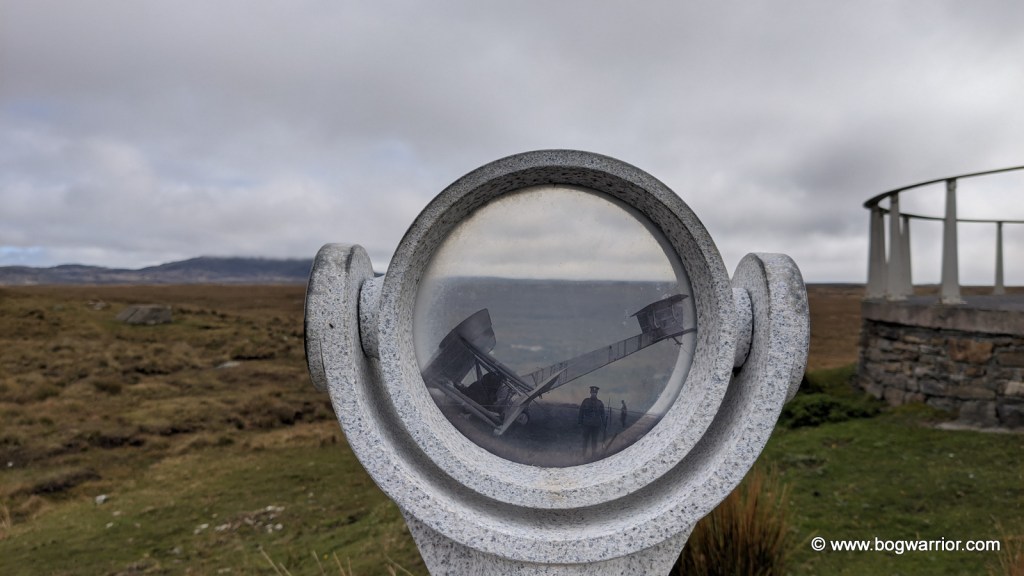
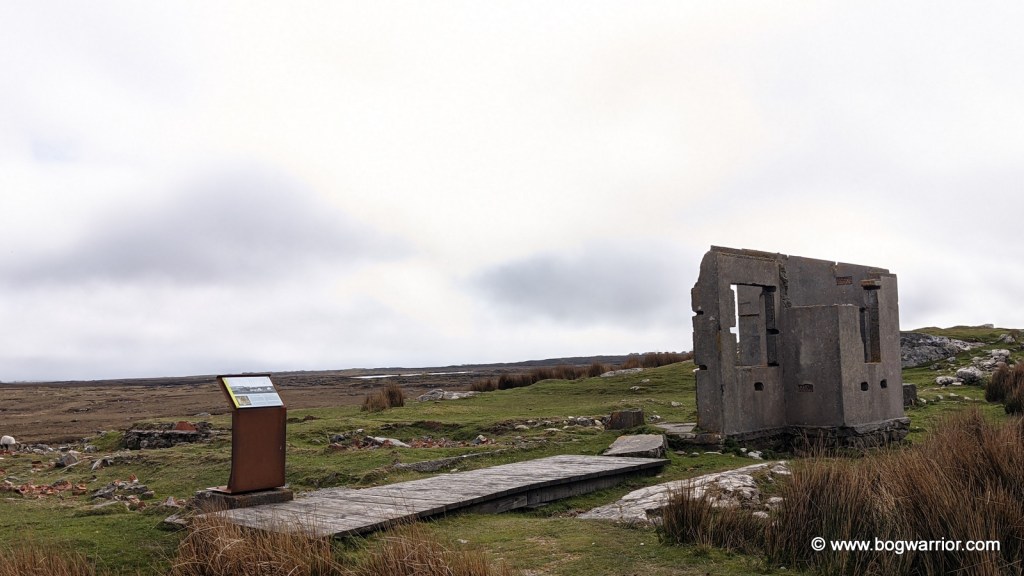
All of this means that despite the significance of this site, and the extent of what used to be here, visitors could easily go for a long walk and return to their cars oblivious. Happily, lots of work has been done to remedy this. Along with pathways and boardwalks, the site is dotted with information stops, photoscopes and helpful signs. All of these definitely help to make you understand how large and unique this site once was. It’s so frustrating that there isn’t even one building standing any more. All we have are tantalising glances of foundations, a few fragments of wall, loose bricks and concrete bases. The photoscopes in particular are a welcome addition because you can look through them and see old photos against the current landscape.
In 2010, a smaller version of the station was recreated for the BBC series Coast. If you’re interested, the episode can be seen here (scroll on to 9:26)

Alcock & Brown’s Soft Landing
On Saturday 14th June 1919, two British pilots – Captain John Alcock and Lieutenant Arthur Whitten Brown set off from Lester’s Field, St. John’s, Newfoundland, Canada in a modified Vickers Vimy aeroplane. Both had flown aeroplanes in World War 1 but they had a slightly more peaceful mission in mind this time. The Daily Mail newspaper (yes, that one) was offering a prize of £10,000 for the first non-stop Transatlantic flight. That’s over €500,000 in today’s money, just in case you were wondering.
Their aircraft was a twin-engined bomber which had been modified for the crossing. Out went the bomb racks and in came extra fuel tanks and oil. To stay warm, both wore electrically heated clothing, Burberry overalls, fur gloves and fur-lined helmets. Alcock took the controls of the plane while Brown did the navigation.
Inevitably, the flight was incident-packed and not in a good way. 3½ hours into the journey, the plane’s wind-driven electrical generator failed. That deprived them of radio contact, their intercom and the heating. They then encountered thick fog which made navigation impossible – Alcock nearly crashed the plane into the sea after losing control of the aircraft. Now freezing cold because of the lack of heating, they encountered a snowstorm. After nearly 16 long hours in the plane, the duo finally made land again. They spotted the antenna at the Marconi station and that helped them get their bearings. Alcock landed the plane in what he thought was a nice green field. Anybody familiar with that part of Connemara would simply say “lol”. Anyway, both men emerged safe and sound from their plane. The plane itself was in reasonably good condition despite the flight but it soon began to sink into the soft ground.

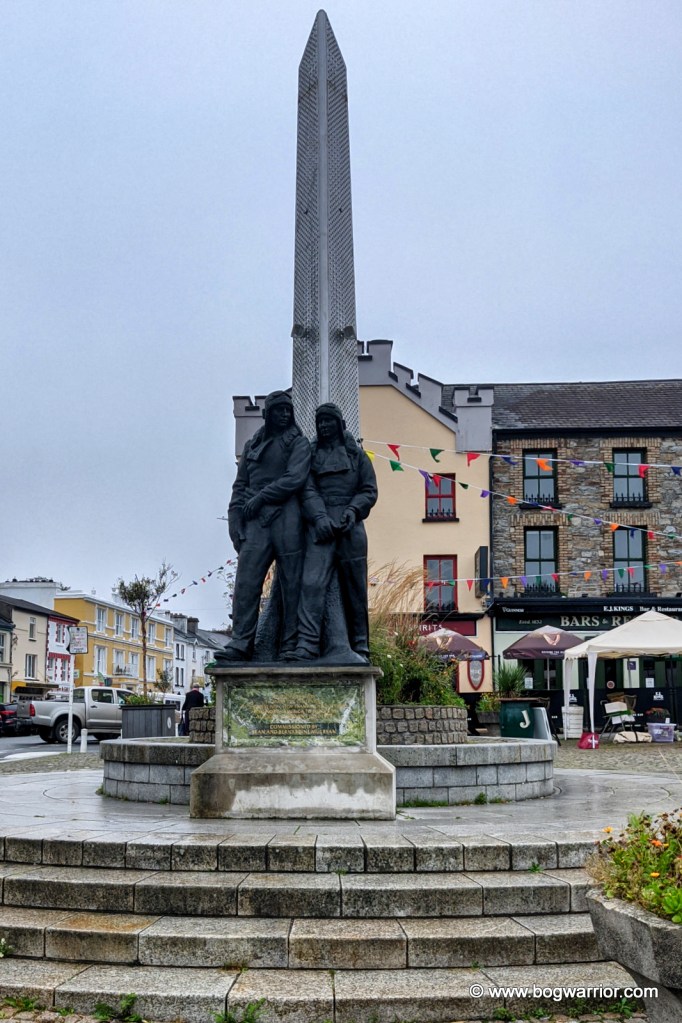
The plane was soon removed from there and can now be seen in the Science Museum in London. The spot where they landed in Derrigimlagh is now overlooked by a viewing platform. Strangely, there is a second Alcock and Brown monument in the area but it’s on the L5132 road to Errislannan.
To sum up, if you want to spend a pleasant few hours walking in the fresh air and taking in the bleak but beautiful Connemara scenery you could do worse than come here.
How to get here: Navigating to here should be marginally less arduous than Alcock & Brown’s flight across the Atlantic. Derrigimlagh Bog is on the R341 between Clifden and Ballyconneely. There is a small car park at the entrance. Needless to say, wear comfortable footwear and at the very least, bring some water with you. You’ll be out there for a while.






Footnotes
- Original version of this photo is from the Laurence Collection and was digitised by the National Library of Ireland ↩︎
- Screenshot taken from Coast, Series 5, Episode 5 “Galway to Arranmore Island” (2010) ↩︎






 Bogwarrior.com