To Irish people of a certain age, the mention of the name Seir Kieran will most likely conjure up memories of the 1980s and 1990s. The days when Offaly could field competitive hurling teams, always featuring handy players from the Seir Kieran GAA club in their. Ah, those were the days…
The Seir Kieran club is located in the small village of Clareen and gets its name from the nearby monastery which has all but vanished. Just like its round tower really
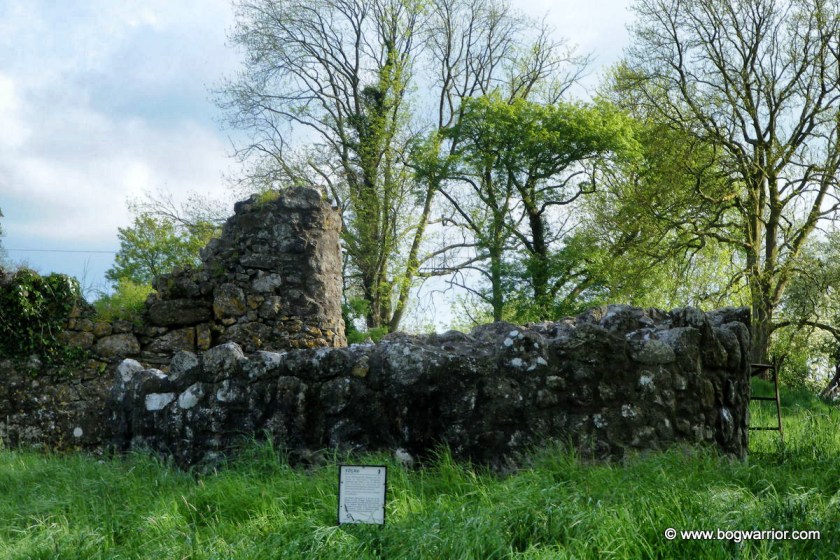
Seir Kieran Round Tower ^
The monastery, known as Saighir, was founded by St. Ciarán the Elder. (Seir Kieran is simply an Anglicisation of the monastery name and its founder). He was given this name to differentiate him from St. Ciarán who founded Clonmacnoise. There is quite a bit of confusion about St. Ciarán’s life and plenty of rabbit holes to go down if you want to figure it all out! The basic facts seem to be that Ciarán was born in the 5th century, possibly in Cape Clear, Co. Cork. He was a Christian before St. Patrick’s arrival into Ireland and may have been studying abroad by then. He seems to have been ordained a Bishop in Rome prior to his return to Ireland. His plan was to be a hermit and he settled in Saighir. However, instead of being left in peace to do hermitty things, people started to flock to him and the place turned into a thriving monastery. In time, Ciarán’s monastery became the burial place for the Kings of Osraige (Ossory), something that would have had quite some status at the time. Ciarán met St. Patrick and became one of his helpers. He became the first Bishop of Ossory – that title continues to this day though the seat is elsewhere.
Over time, Saighir fell into decline. It wasn’t helped by being raided by the Vikings but being superseded by Aghaboe Abbey 30km away was the death knell really. It was finally dissolved in 1568, as part of King Henry VIII’s dissolution of the monasteries.
Little remains of St Ciarán’s monastery or the round tower. There is now a 19th century Church of Ireland church built on the site. It is possible that it is standing in much the same place as the original monastery church would have stood. The church (which I haven’t been inside) contains a number of early medieval memorial slabs which probably were here prior to it being built. The round tower is close by but there isn’t a lot to see now.
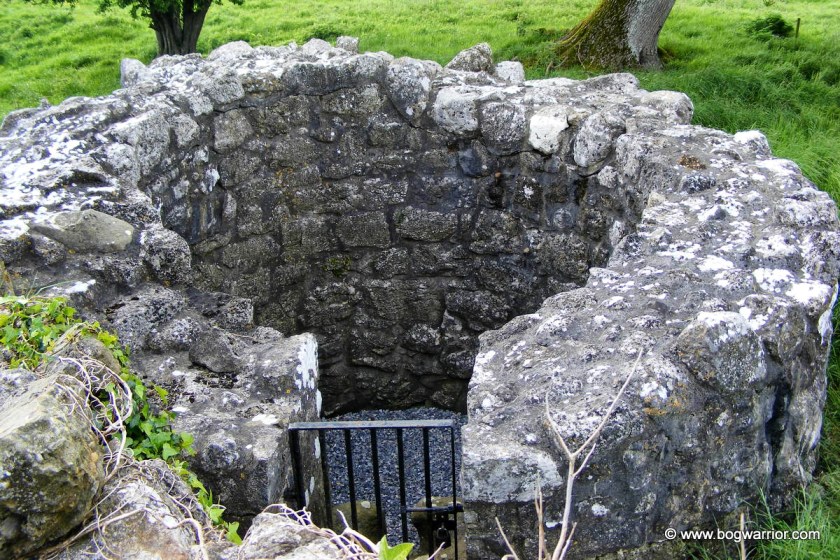
There are just 6 courses of stones remaining of the tower overground and it is sitting in a field at a lower level to the rest of the adjoining grave yard. The basement can still be seen and taking that into account, it brings its height to 2.9m high. Its diameter at the base is 5.14m. Still, it is possible to see just how thick the walls of these towers were.
The entrance gate to the tower was added later. There is a bullaun stone embedded in the wall of the tower under the gate. Nobody knows what these were for but they are often found in old ecclesiastical sites.
Elsewhere, there is the base of a 10th century high cross. And that more or less sums up what’s to be found here.
Date of Visit: 22nd May 2009
Getting there
The site is just outside the village of Clareen. It is signposted from the road and is easy to get to (link).
Whether it’s worth it or not is debatable. There is quite a bit of history attached to this monastery and to St. Ciarán but not a lot to see if you’re a tower spotter.
Vital Tower Stats
Height: 2.9m
Diameter at Base: 5.14m
Height at Door-Sill: Unknown
Suggested Date: Unknown
Stats from The Irish Round Tower: Origins and Architecture Explored by Brian Lalor
Published by Collins Press, Cork (2005)
ISBN 10: 1903464773 ISBN 13: 9781903464779
I’ve been a bit of a tower enthusiast for as long as I can remember. As a small child, no journey in my parents’ car was complete without me spotting water towers and excitedly pointing them out to them. Sigmund Freud would’ve had a field day 😀 Anyway, I came to my senses and decided that water towers were rather underwhelming and really not worth seeking out. Instead, I turned my attention to round towers.
These are somewhat enigmatic, narrow, cylindrical stone towers which were built almost 1,000 years ago mostly in Ireland. Just three of them exist abroad; one in the Isle of Man, two in Scotland. Even at that, it’s likely there was an Irish hand or two involved it their construction. The first one I ever saw was O’Rourke’s Tower in Clonmacnoise and it made quite an impression (“What happened to the roof? Where’s the door?”). When I moved into my teens, I led my cousin and her friends on an expedition to explore the nearby round tower in Swords. These towers also inspired me to make a collage at primary school but more of that later.
O’Rourke’s Tower, Clonmacnoise, Co. OffalyCloigtheach/Round Tower as depicted on an old Ordnance Survey map
The clue to what an Irish round tower is lies in the Irish name for them. Cloigtheach means “bell house” or belfry. Indeed, some of these towers still stand beside the churches for which they were built.
It is believed that 80(ish) of them were built between the 10th and 13th centuries. There are references to some of them in ancient writings, such as the Irish Annals. The first reference to one dates back to 950AD when the Vikings burned one in Slane, Co. Meath. The latest one was in Annaghdown Co. Galway in 1238. Both these towers have sadly vanished without a trace. As of 2020, there are 74 of them which can be visited. Some are in very good condition and there are still two of them which can be can be climbed (Kilkenny and Kildare). The tower on Devenish Island, Co. Fermanagh has also been climbable but it is unclear whether it is still the case. If anybody knows for sure and lets me know, I will happily amend this post. The others are in various states of repair; going from towers which still have their roofs to those which barely exist at all.
Despite the towers being labelled as Cloigtheachs, my primary school teachers didn’t get the memo. Being told that the towers were used as safe refuges for the monks and their treasures when marauding Vikings came-a-raiding fired my imagination. Aged 10 or 11, I made a collage of a daring monastery raid using felt and some other scraps of cloth which were lying was lying around in the classroom. The collage is long gone of course but you will be delighted to know that I’ve replicated it using modern technology. Sadly, drawing apps don’t give you the same smell of glue as 1980s art classes. What the teachers didn’t tell us was that (a) round towers can’t actually hold many people/things and (b) they’re just about the worst place you could hide out in from raiders. They are eminently burnable. Given the shape of the towers and the wooden floors that were in them, they had the potential to become deadly furnaces if they were set on fire. And it appears that that is what happened sometimes. There are records of towers being set on fire and people dying in them. The King of Fermanagh met his end in the tower on Devenish Island in County Fermanagh. The son of the King of Tara was murdered in Kells. The tower at Dysert O’Dea in County Clare was burned at some point. Nobody knows when or why but there is still a crack in its wall.
A Viking raid on a fictional monastery. Not based on true events.
No two round towers are alike. There are variations in the building materials used, the style of the doors and windows and in the width and height of them. Still, they all follow a certain formula. They’re slender, stone towers which stand up to 40 metres in height. Their doorways tend to be located 2-3 meters from the ground and can only be accessed by a ladder. The windows are higher up in the tower and are narrow slits. Most of the towers are/were topped with a conical shaped roof. The doors of the towers face the west doorway of the churches they were a bell-tower for. And despite their heights, none of the towers appear to have had particularly deep foundations. Despite this, most of them are still standing
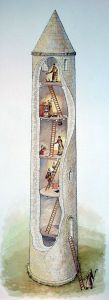
The image on the left isn’t my handwork (I think you can see who the real artist is here…) but it gives a good idea of what the interior of the towers was like. I found it on Pinterest so if by some chance someone knows who drew it, I will happily give credit for it.
Each tower had a basement and then a series of floors going from the doorway right up to the top of the building. It is thought that the floors were connected by ladders. Having climbed the tower in Kilkenny, I can confirm that this isn’t for the faint-hearted. There wasn’t always much room inside the towers either so it’s debatable how many things were ever stored in there.
In the coming weeks, I shall write a little about the round towers I have visited. Here is a selection of them. Being a biased Offaly woman, I plan to start where the madness all began – Clonmacnoise.
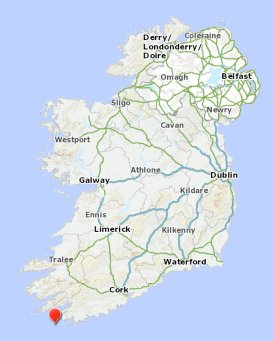
Mizen Head is Ireland’s equivalent of Land’s End in the UK. In other words, it’s almost Ireland’s most southerly point but doesn’t quite manage that. That honour falls to the nearby Brow Head which is probably best known to people who like to point out that particular piece of trivia. Anyway, regardless of which headland you’re heading for, getting there can be a somewhat hair-raising experience. The roads are of the narrower, twistier variety and some of the locals seem to be wannabe Formula 1 drivers. So be on your guard, especially at bends.
A Fog Signal Station was built at the tip of Mizen Head in 1909. It was manned until 1993, after which it became a visitor centre. The original visitor centre was housed in the Lightkeepers’ Quarters until 2001, when the new visitor centre was built. There are still interesting exhibits in these old buildings. These include some of the old equipment used by the Lightkeepers, maps and charts. There is a stunning mural dedicated to the birds of the area in one of the buildings which is pure eye candy. Guglielmo Marconi carried out some of his earliest trans-Atlantic radio transmissions from the nearby village of Crookhaven (you can read more about it here) and there is information and equipment about his work in the radio room.
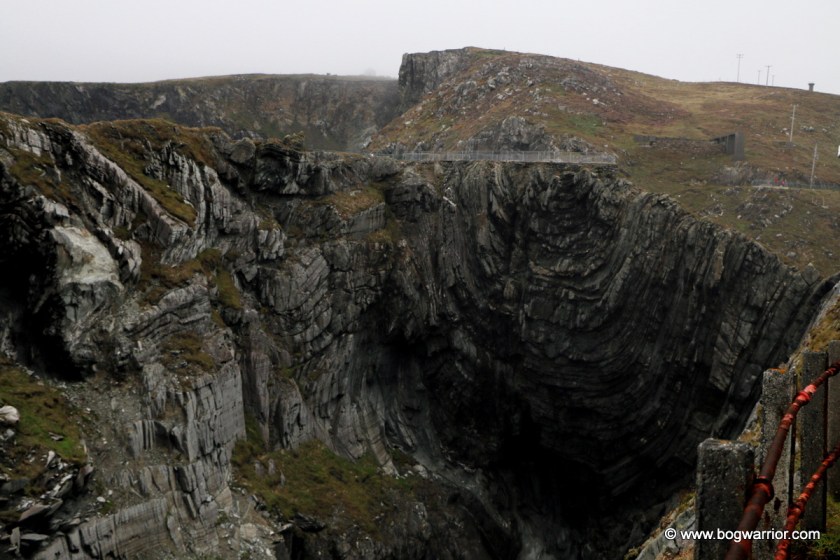
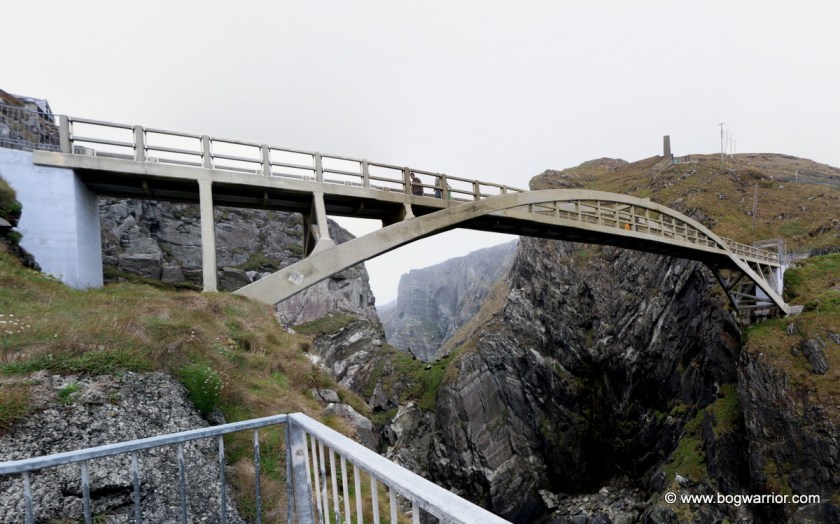
The best known feature at the Mizen Head Fog Signal Station is the beautiful suspension bridge which spans a gorge between the mainland and the tip of the headland. The original footbridge was constructed in 1909 and was one of the first bridges to use precast elements. It was the largest bridge of its kind at the time, with a span of 50m. In the early 2000s, it reached the end of its lifespan. It was decided to demolish the bridge and replace it with an almost identical replica. The new one is wider but is still built from reinforced concrete. If you want to nerd out and read all about the demolition of the old bridge and the construction of the new one, you can take a look at this
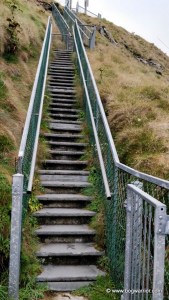
The 99 Steps
Mostly though, it’s the scenery that takes your breath away. Even though you can see that it was an overcast day when I was there, it did little to diminish the impact of the surroundings. It also made me wish I’d bothered to listen more closely in geography class because all around were spectacular real-life examples of all sorts of things we were told about. It’s largely Devonian sandstone in the area and you can really see evidence of how the landscape was formed
FoldingRadio Signal Hut. One careful owner
The walk out to the signal station itself is punctuated by various exhibits and viewing platforms. These include a sea arch (revives memories of geography class again) and a replica of a floor from the Fastnet Rock lighthouse which is 15km away, out in the Atlantic Ocean)
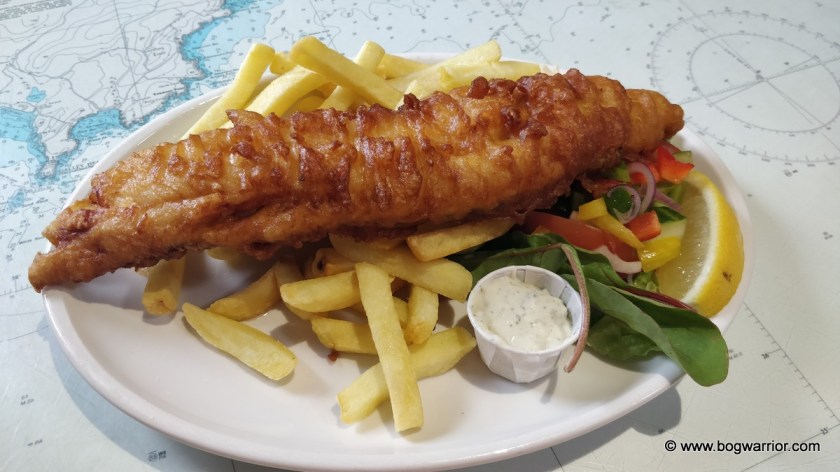
The Visitor’s Centre is worth a mention too. It has plenty of information, photographs and models of the area. Kudos too to the gift shop for not having cheesy new-wave Celtic mystic trip playing as you browse. And after doing all that walking and exploring, I couldn’t wait to tuck into the haddock and chips which were on the menu in the visitor centre’s cafe.
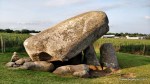
The Brownshill Dolmen can be found not too far outside Carlow town. What’s nice about this one is that it’s easy to get to. There’s a car park outside and a fenced-off walkway that leads from there to the dolmen itself. So although you still feel like you’re almost in someone’s field, you’re safe from marauding bulls, crops that behave like Triffids and erm…I’ll stop now.
Anyway, if you’re in search of a good dolmen, you can’t do much better than the Brownshill Dolmen. There are approximately 190 of them in Ireland, though they can also be found in other European countries and in Asia. This one has never been excavated, possibly because its capstone is estimated to weigh 150 tons. How the people who built it roughly 5,000 years ago managed it is sadly lost in the mist of times. It is believed that this one is the largest in Europe.
Dolmens usually consist of 2-3 stones, topped by a large capstone. It is believed that they would have originally been topped by mounds of stones. These have long since vanished, leaving behind a “skeleton”. Although they’re generally described as being tombs, there isn’t any concrete evidence one way or the other to say for sure that they were.
The main entrance into the building – the one for the ladies
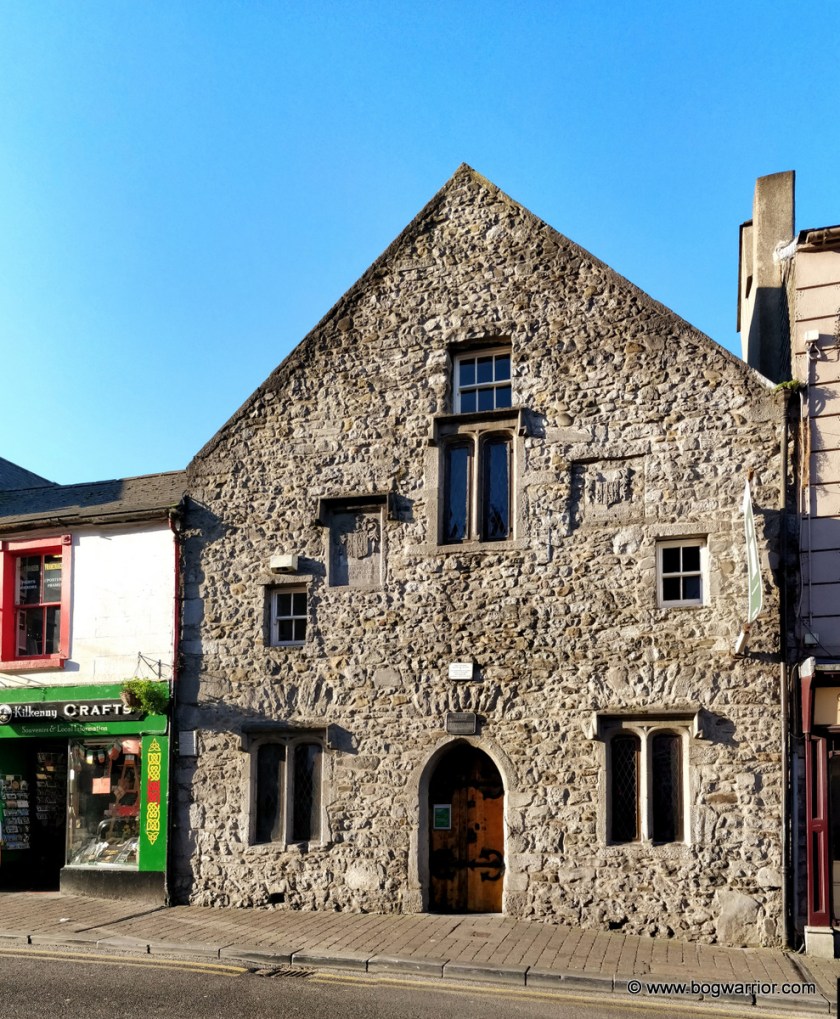
The current home for the tourist office in Kilkenny is an old building with an interesting history. It was built in 1581/2 by Sir Richard Shee, a wealthy local man. Depending on what source you read, he either made a profit from speculating on church property during the Reformation or he bought up a lot of it to keep it out of the hands of reformers. Regardless, he seems to have started to worry about burning in hell (as you do) and established this almshouse to help the poor.
It was built to house 12 people. “6 honest, poor, unmarried men” and “6 widows of 50 years of age or more”. Each resident had their own room (which must have been tiny, judging by the size of the building) but there were some strict regulations they had to abide by. For starters, everyone had to attend 2 hours of prayer every day and would face instant eviction if they got drunk, indulged in hanky panky or refused to attend weekly religious services.
The entrance for the men which leads straight onto the first floor
To ensure the men and women in the almshouse didn’t get up to any funny business, the building had two floors which were not connected internally. The ground floor was for women only – this is the more prominent entrance to the building these days because it faces out onto Rose Inn Street. The men lived on the first floor and the entrance to there is on a laneway to the rear of the building. These days there is a staircase which connects the two floors.
The almshouse continued to house the poor until 1830 or so. By that stage it was no longer in the hands of the Shee family – it had been sold in 1752 by Edmund Shee. It then fell into ruin and was renovated in the 1870s by Sir Nicholas Power O’Shee who was a descendant of Richard Shee. As well as being an almshouse, it was used as a Catholic chapel, a hospital and even a shop. In 1978, it was obtained by Kilkenny Corporation who restored it and opened it as the tourist office.
In the early 1990s I attended Maynooth University, eventually graduating with some letters after my name, oodles of soon-to-be-forgotten information in my head and a horror of getting out of bed before 10am. Happy times 😉 Then, as now, the campus was split between two campuses. The shiny shiny North Campus has changed almost beyond recognition from my undergraduate days. Then there’s the South Campus which is shared with the Catholic Seminary established back in 1795. It has scarcely changed since my student days and there’s something nice and comforting about that. It’s a nice place to walk around, though I’m not sure many people do. My guess is that even fewer people know that there’s a rather good science museum a few minutes walk from the entrance gates.
St Joseph’s Square and the approximate location of the museum
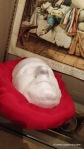
The museum has been in existence since 1934. Indeed, it was there when I was a student but somehow I never got around to popping in for a look. Then, as now, it had restricted visiting hours. It only opens on Wednesday and Sunday afternoons during the summer months and by appointment at other times. When it was first set up, the museum housed just ecclesiastical items. There is still a section in there dedicated to that but I’m afraid priests’ vestments, holy pictures, chalices, rosary beads etc. don’t really float my boat. Perhaps bridging the gap between religion and er…the grisly, Daniel O’Connell’s death mask is on display. Far more interesting to me is the science section which was later added.
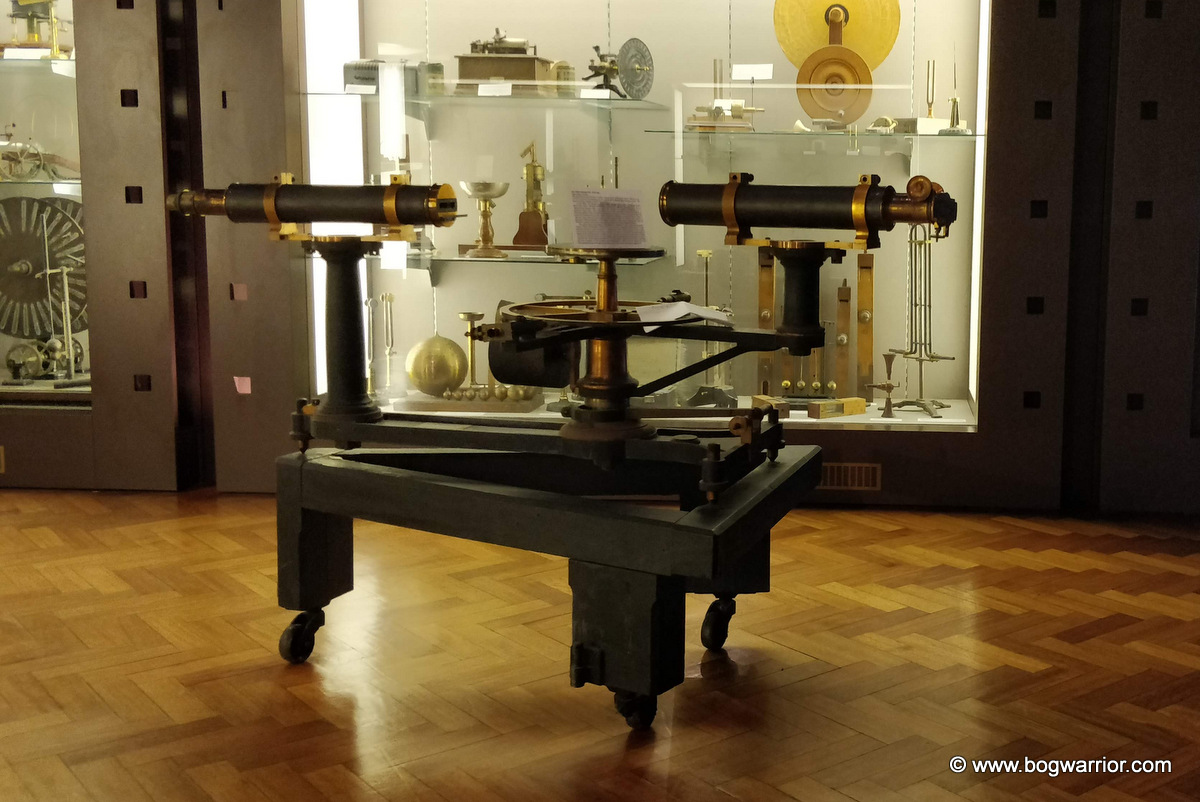
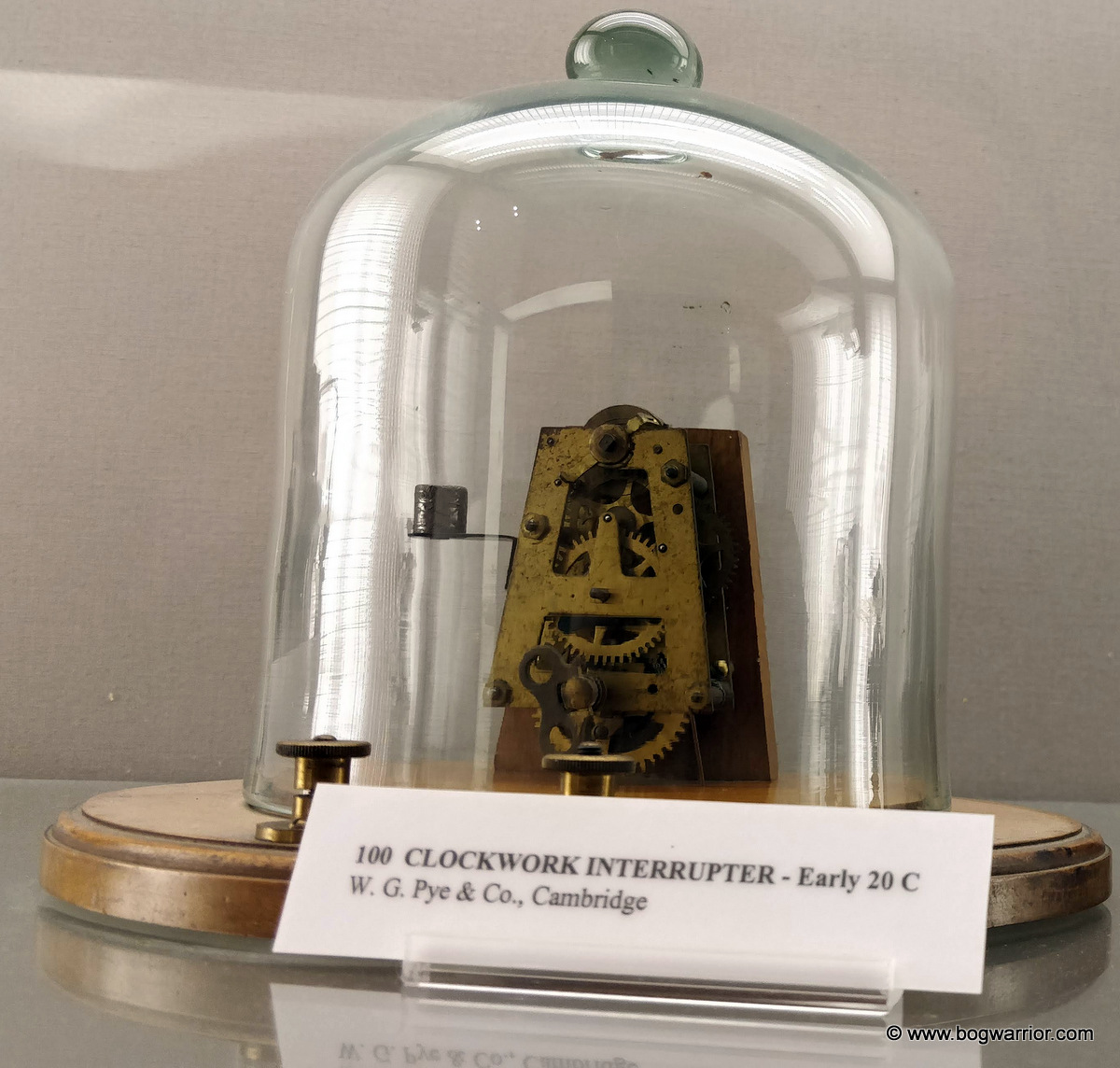
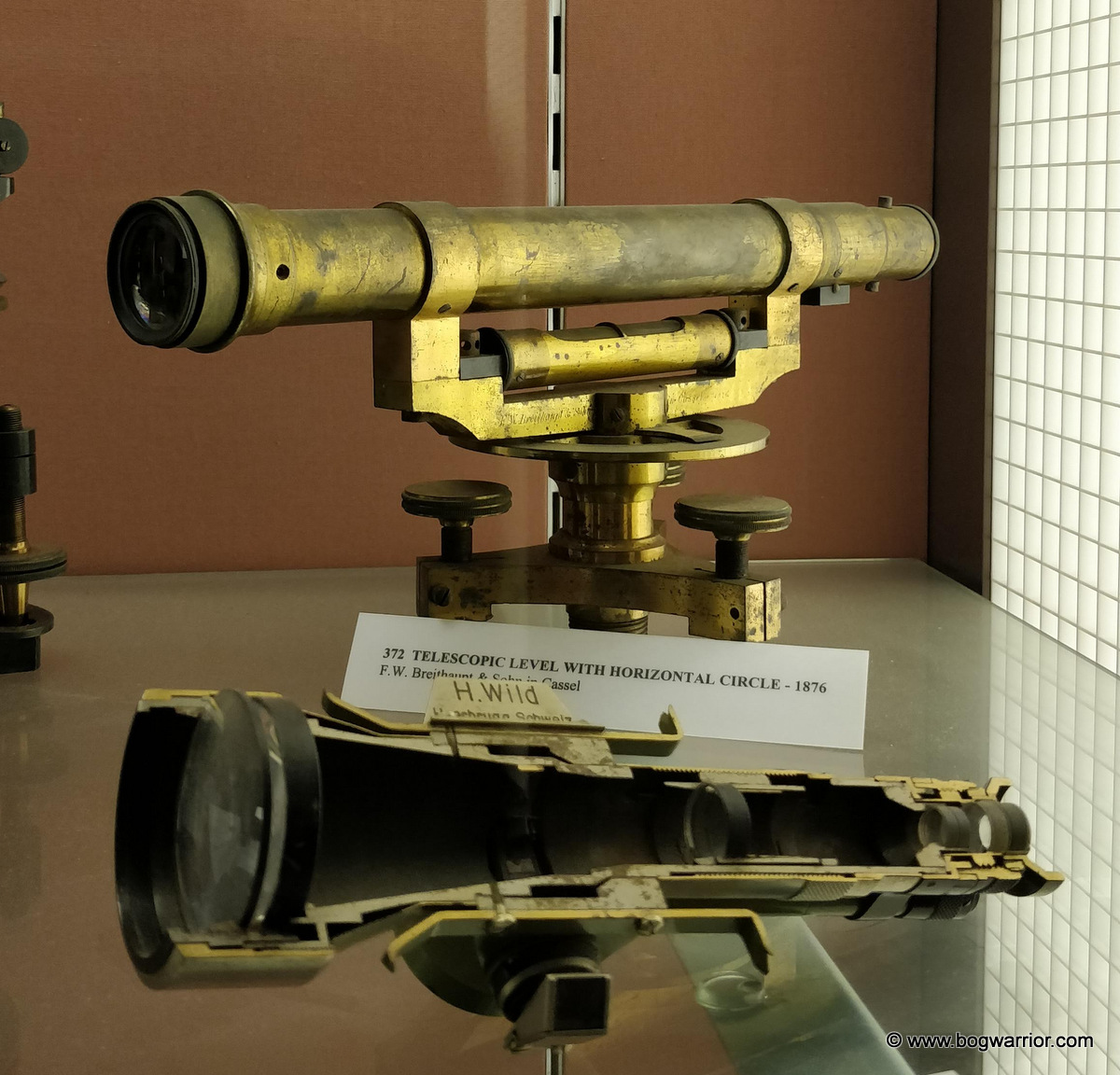
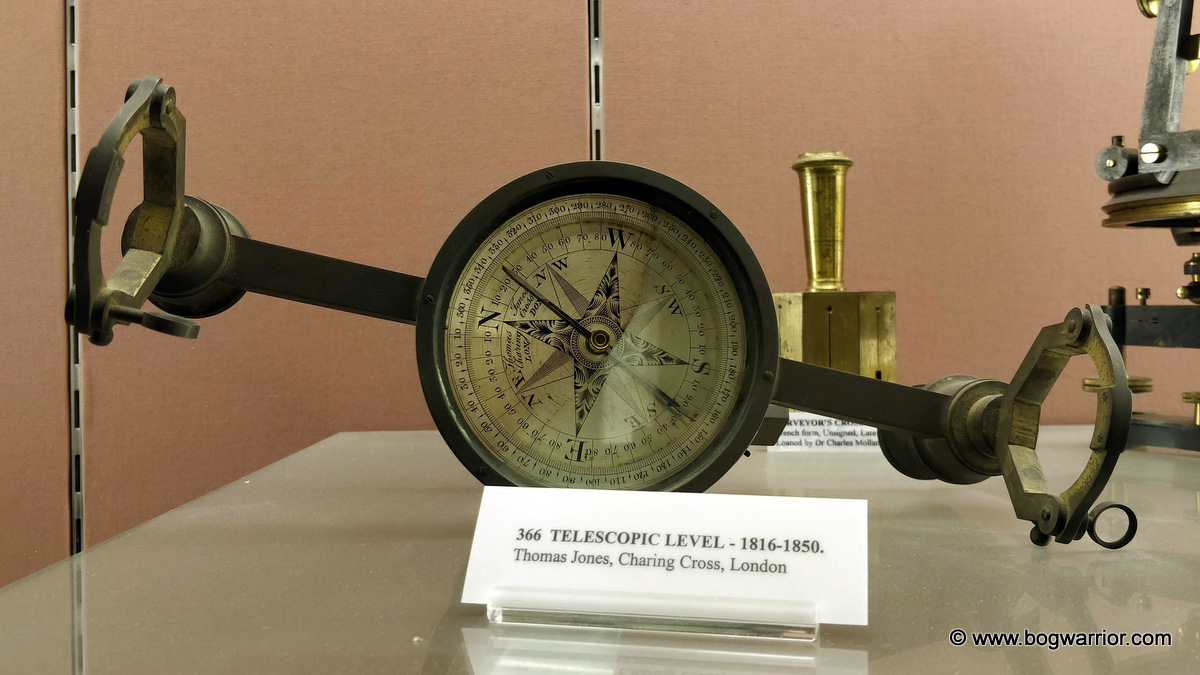
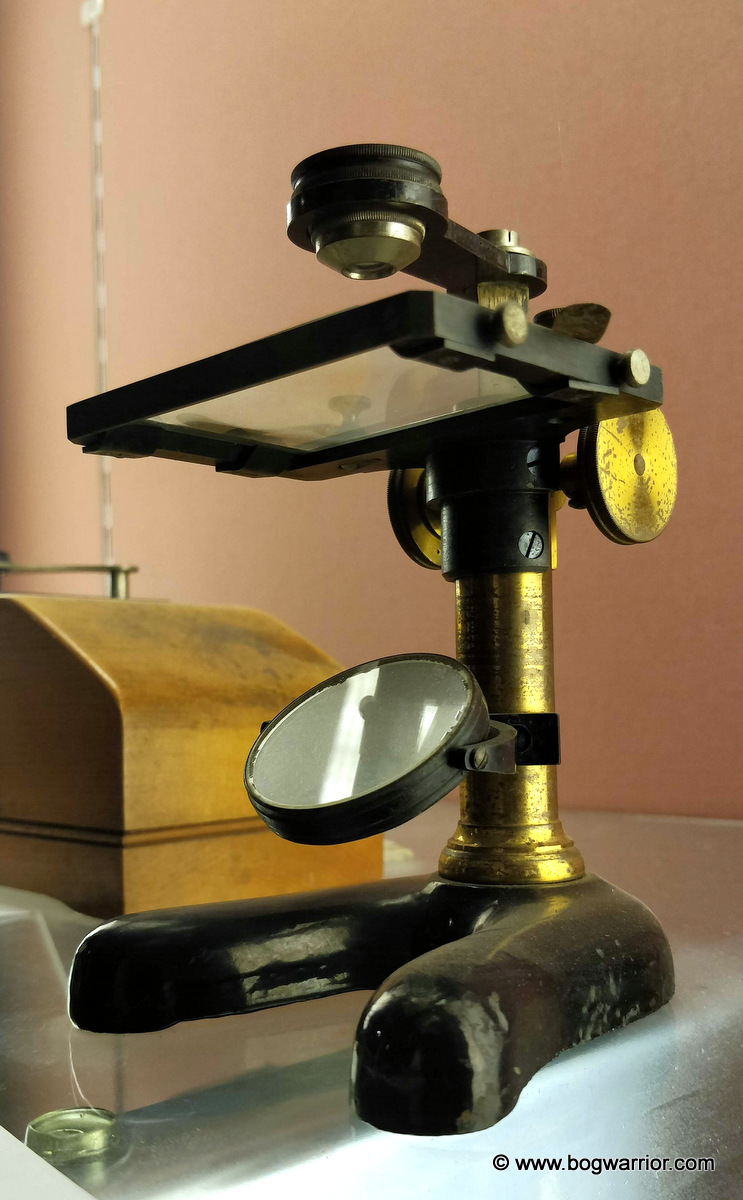
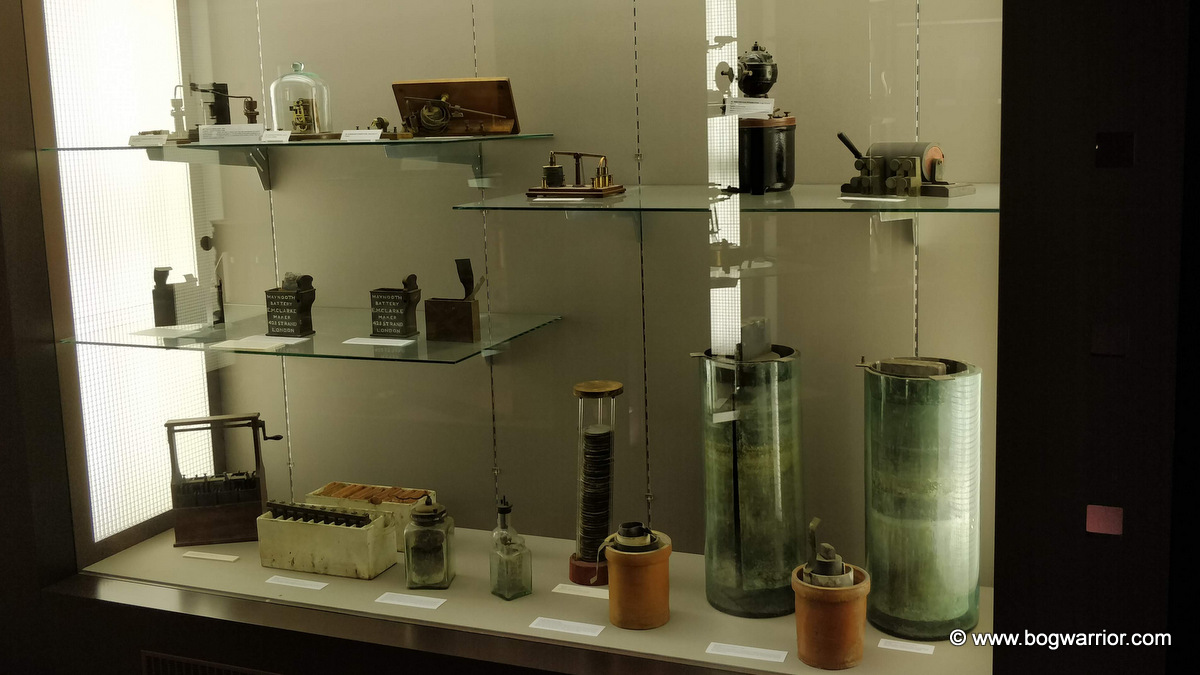
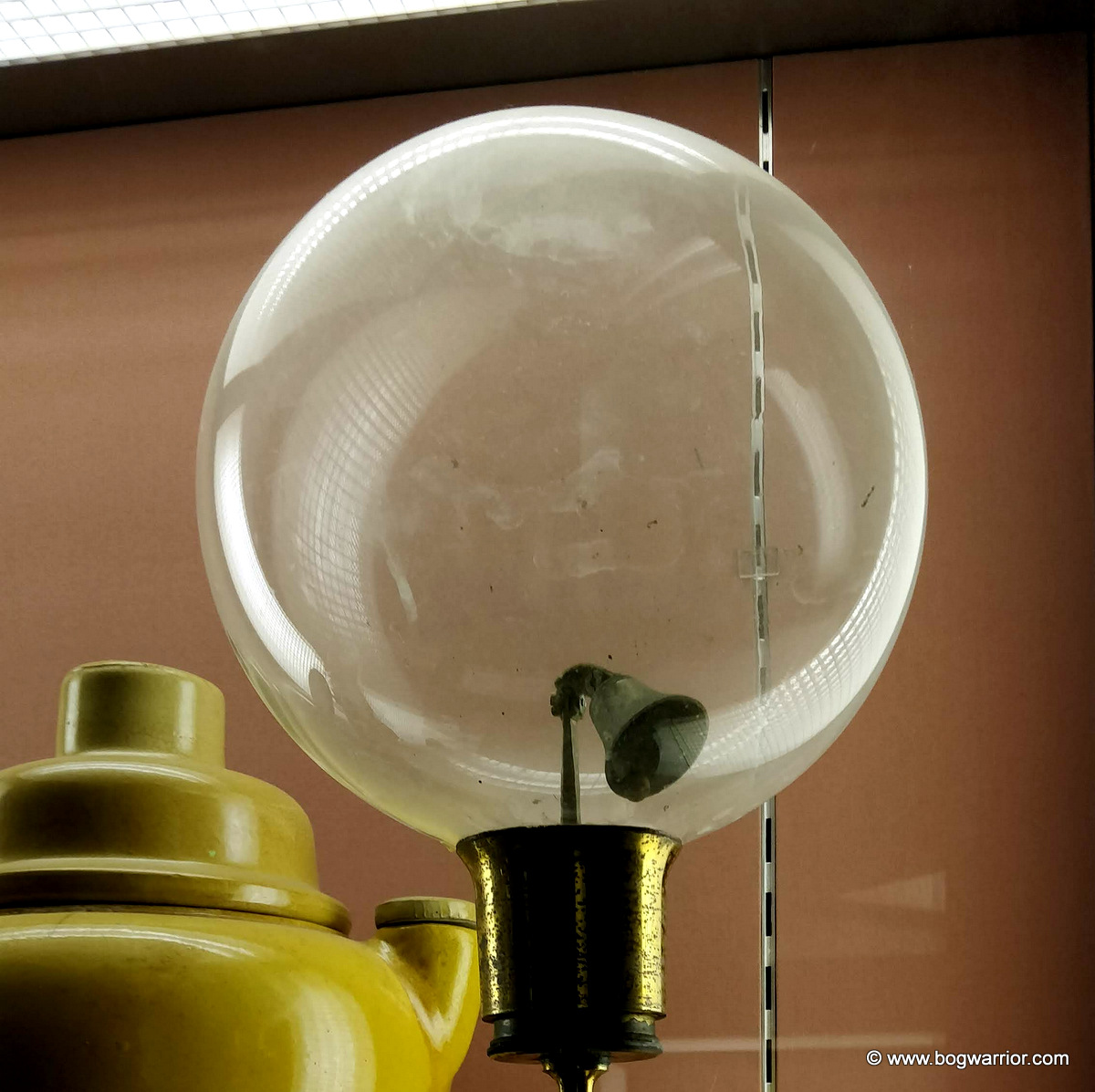
At first, many of the early scientific artefacts added to the collection were connected with Maynooth’s most famous scientist. The Reverend Professor Nicholas Callan, a man who should probably be better known than he is. In 1975, Chemistry Professor Fr. Michael Casey became curator of the museum and he remained in that position until 1998. Under his watch, the collection was expanded greatly. Staff went through the cupboards in the various science departments in the college and unearthed items they felt would be worth putting on display. As it turned out, these cupboards turned out to be a something of an Aladdin’s cave. The museum now has Ireland’s largest collection of scientific instruments on public display. The display cabinets in the place are full of everything from microscopes to telescopes to an early GPS unit. The sheer quantity of items on display is astonishing, seeing as it’s in an obscure little museum.
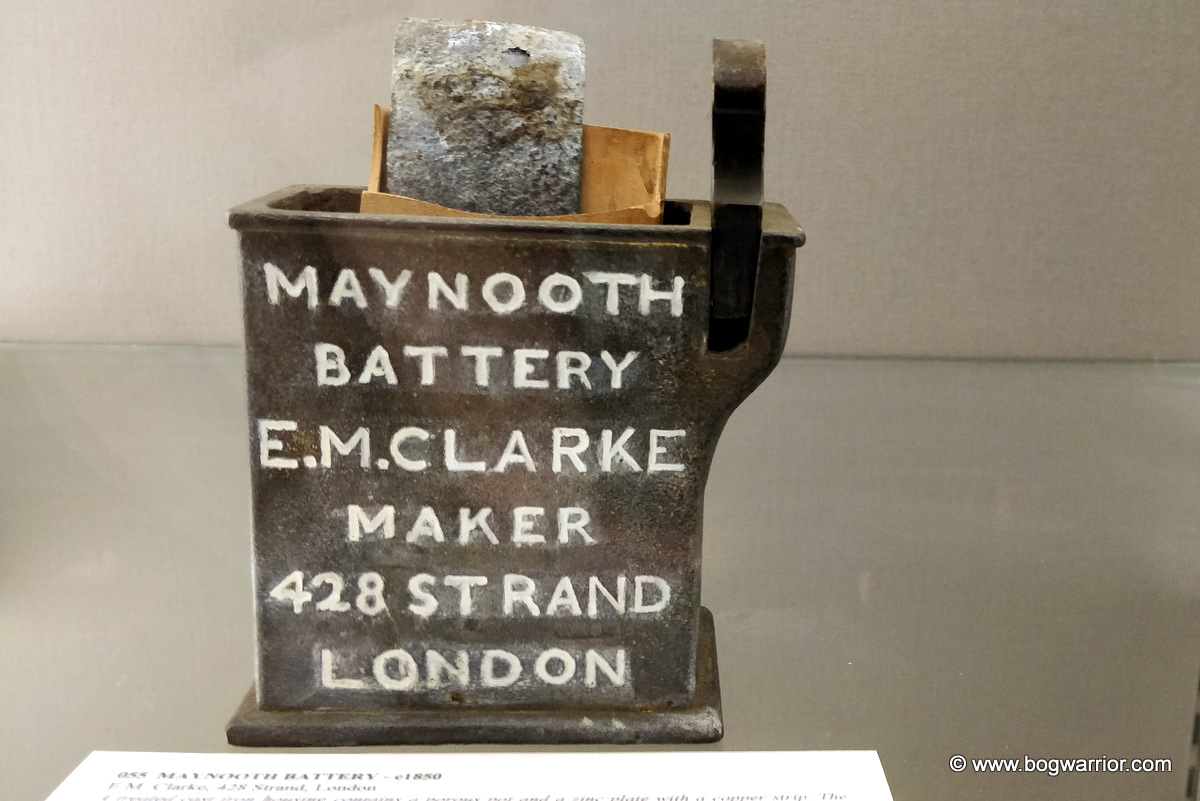
Professor Nicholas Callan’s Maynooth Battery. Revolutionary in its time but maybe not small enough to fit in a smartphone
The Reverend Professor Nicholas Callan (1799-1864) invented the Induction Coil. For a number of reasons, including him being attached to a seminary rather than a scientific institution, his work was overlooked. He wasn’t given credit for its invention during his lifetime (its invention was attributed to Heinrich Ruhmkorff) but that has since changed. He also invented what became known as the “Maynooth Battery” which improved greatly on previous batteries that already existed. It was commercially successful and has been described as the Duracell of its time. Some of his batteries are on display, as is his induction coil and many other pieces of scientific equipment he created or worked with.
Perhaps now is the time for me to mention my favourite anecdote about the Reverend Callan. He liked to experiment with his batteries and once connected 577 of them together. There weren’t any ways at the time to measure how strong the batteries were so he used to experiment in different ways. One of them was to administer electric shocks to his students. One shock was so severe, it knocked out the future Archbishop of Dublin. After that, he switched (or was ordered to switch) over to turkeys instead.
The museum is well worth a visit if you have an interest in the history of electricity and in old scientific instruments. From what I can gather, very few people know it even exists. Perhaps it is a victim of its restricted opening hours and its location. It’s well worth the effort though. Entry is free but you can pay a voluntary donation.
How to find the museum
Walk in through the college gates which are close to Maynooth Castle. Then immediately turn left and follow the path for 250m or so. You will start to see signs for the museum.
I’ve been in or around the seaside town of Duncannon many times but until this year had never got around to visiting its star-shaped fort. I’ve seen it from a distance, I’ve looked up at it from the beach that lies underneath it and I’ve even walked past the entrance gates. The fort, which has long since ceased to be an active facility, is open to the public during the summer months. And as I discovered when I finally did get around to visiting and took the excellent guided tour, it’s a fascinating work in progress.
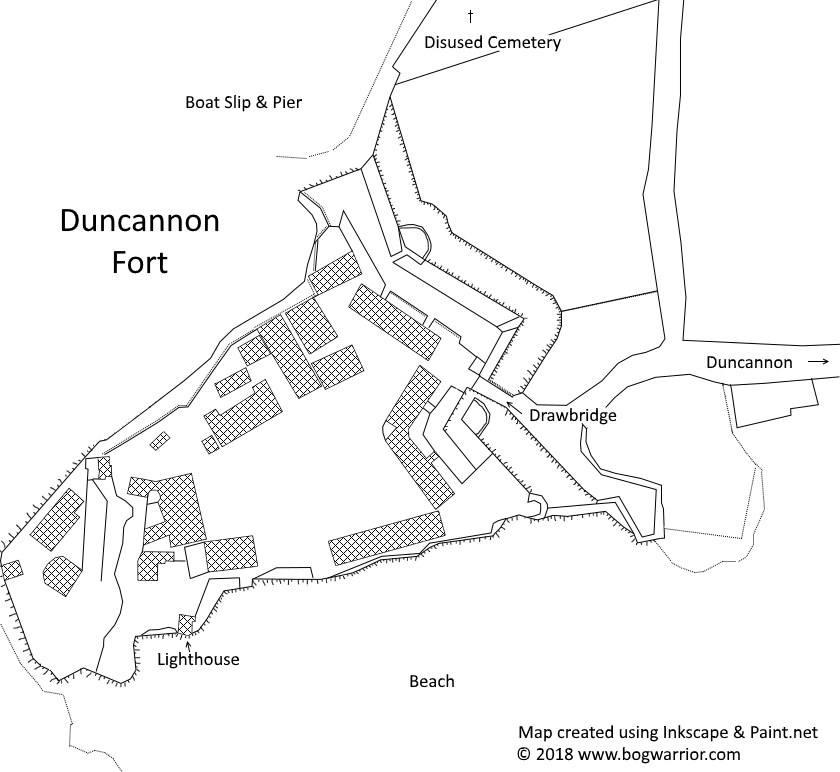
The layout of the fort as it is today
A Brief History
The fort is built at the tip of a peninsula, overlooking the entrance into Waterford Harbour. As strategic locations go, it’s one of the better ones. The width of the bay and the layout/depth of the channel means that one fort is enough for keeping an eye on anything coming and going by sea. More bang for your buck when it comes to forts. Perhaps unsurprisingly, the fort which stands here now isn’t the first one to have been built on the site. The present fort dates from the 16th century but it was had previously been home to a Norman fort of some sort in the 12th century. There is also evidence that suggests there was a wooden fort here going further back into history. Old maps from the 16th/17th century show a ruined church, a castle and some defensive structures on the site. These are long gone but the stone from them has no doubt been reincorporated into what’s here now.
Fearing an invasion by the Spanish Armada, the present fort was built by Queen Elizabeth I in 1587-88. They never arrived but that didn’t mean that it didn’t get to see some action. In 1645 it was captured by Irish Catholic Confederation forces and remained under their control until 1650. Oliver Cromwell, arguably the least popular Englishman to ever tread on Irish soil, tried but failed to recapture it a year earlier. His son-in-law Henry Ireton got his hands on it a year later. It is believed that both monarchs who fought in the Battle of the Boyne in 1690 stayed in Duncannon Fort before leaving the country. King James II left for France on 3rd July 1690 whilst the victorious William of Orange stayed there in September of the same year.
During the 1798 Rebellion, the fort remained under British control. Indeed, it became a prison for captured Irish rebels and a place where some of them were executed. Depending on which version of the Irish rebel song “The Croppy Boy” you listen to, the title character meets his end in Duncannon. Or Dungannon which is at the other end of the country..
The entrance into the fort, as viewed from the dry moat
In Samuel Lewis’s Topographical Dictionary of Ireland (1837) the fort is described as “..adapted for mounting 42 pieces of cannon, and, including ” the bombproof” erected in 1815, contains barracks for 10 officers and 160 men, residences for the chaplain, fort-major, storekeeper, and other officers, and a chapel for the garrison; the whole is surrounded by a dry moat crossed by a drawbridge, and the only entrance is defended by a portcullis.”
The buildings in the fort were built at different times but look more uniform these days because of changes made to the site in the run-up to World War I. They were covered with roughcast and Tarmacadam was poured on the ground. This covered over the cobblestones which had been there. At least one archway was knocked so that tanks could be driven into the fort. Despite the alterations, there are still many older features remaining intact. The dry moat and sloping walls, circular lunette fortifications, tunnels and gun batteries being some of these.
The fort was handed over to the Irish Army in 1922 when British rule ended here. It was largely burnt down during the civil war the following year. With the onset of World War II (a.k.a. “The Emergency” because we didn’t do wars here) the fort was partially rebuilt and a military presence reinstated. The old Governor’s house now has 1943 (the year it was rebuilt) and the logo of the Irish army on the front of it.
Burke’s House
A caretaker’s house (locally known as Burke’s house, after the family who lived in it) was built in 1939 as part of the refortification. Unlike the other buildings here, its front door isn’t level with the ground but has steps up to its front door. This is because when they began to excavate the foundations, they found some human remains. It’s thought this is where a graveyard had been. It’s known that at one stage there was a church close by.
The fort was used as a camp for the Reserve Defence Forces for many years, before finally being handed over to Wexford County Council in 1993. As of 2018, there are still parts of the fort which are too dangerous for members of the public to access. Happily, there are still many places which are safe and will give the visitor a good overall view of what life was like in a place like this.
The fort is also visible from the beach below. As the tour guide remarked, the window which overlooks the beach now has iron bars on it to ward off a newer type of invader.
Visitor Information
Duncannon Fort is only open during the summer months. Tickets can be bought in advance or on the day. The official website for opening dates/times is https://duncannonfort.ie/ Admission is by guided tour only but it’s well worth it.
– Click on a thumbnail to launch the gallery –
The fort, as seen from the beach
Burke’s House
The entrance into the fort, as viewed from the dry moat
Kilmainham Gaol has been on my “to visit” list for a while. Finally, I got around to visiting it in March 2018. And boy, was it worth it. And yes, they let me out when the tour was over 🙂
A Little Bit of History
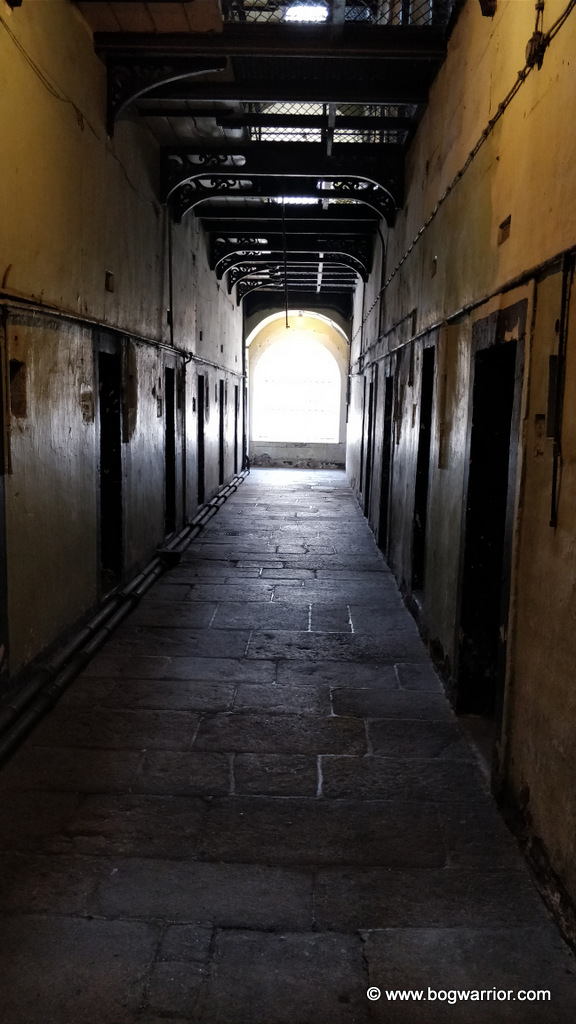
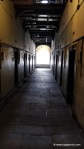
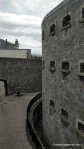
Kilmainham Gaol opened in 1796, built on top of the cheerily named Gallows Hill. There had been an older prison nearby before this and, as the hill’s name suggests, a history of executions in the area. To really add to the general misery of the place, the prison itself was built from a local limestone known as calp. A stone that was good at being damp and poor at retaining heat. And if that wasn’t bad enough, there was no glass in the little windows running along the corridors. Ah yes, they don’t make prisons like they used to do.
Part of the older wing of the prison. Grim, I think they call it.
In the first half of the 19th century, deporting convicts to prison colonies in Australia was still a common occurrence. The prison became the holding place for over 4,000 convicts before they were sent on their long, one-way trip Down Under. Life was scarcely better for the people they’d left behind. Overcrowding had been a problem in the prison anyway but once the Great Famine began in the mid-1840s, it escalated. In those times, one could be jailed for misdemeanours as trivial as begging and stealing food. Needless to say, the prison became very overcrowded during those years. Often people deliberately got themselves arrested so they could go to prison. It might have been miserable in there but at least they’d be fed. The cells which were designed to house just one person became home to four or five people. Women and children slept on the chilly corridors outside. The food wasn’t all that great either and as time went on, the miserly rations were reduced to deter people from going to prison in order to to be fed. Still, it was still a hell of a lot better than what they would have received outside.
In Ireland, the prison is most associated with its role in the struggle for Irish independence. Or perhaps more accurately, for the number of “big names” from Irish nationalism who were imprisoned there. Indeed, there are death masks for Wolfe Tone and Robert Emmett in the prison’s museum. The prison mostly closed in 1910 but found itself unexpectedly brought back into use in 1916 in the aftermath of the Easter Rising.
Hundreds of participants from the Easter Rising were imprisoned here. And in a move which was to change Irish history forever, 14 of the leaders of the Rising were hastily tried and sentenced to death. Over the course of a few days, they were executed by firing squad in the Stonebreaker’s Yard. The executions helped turn public opinion firmly against the British and triggered a series of events which led to Irish independence.
The old wing of the prison. Not warm!
The prison finally closed in 1924 and over the years, fell into disrepair. With the unhappy role it had played in Irish history, it’s understandable why it was left to rot. Thankfully, that all changed in 1960 when volunteers began to restore the prison. It was reopened in 1966 (the 50th anniversary of the Easter Rising). Ironically, the opening ceremony was performed by Eamonn DeValera. In 1924 he had been the final prisoner to be released from the prison; 42 years later he was President of Ireland. It was finally handed over to the Irish state 1986 and is now run by the Office of Public Works.
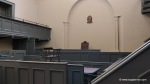
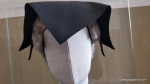
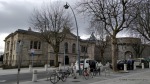
Since 2016, Kilmainham Courthouse which is right beside the prison has been part of the complex. As well as being a good place for visitors to wait for their guided tour to begin, it is an interesting place in its own right. I found the courtroom, with its maze of seats and partitions, to be a sobering enough place in its own right. And that was before I spotted a replica of a judge’s black cap in a glass case next door. What a terrifying spectacle that must have been for the condemned man/woman to see.
The tour of the prison is by guided tour only. Anyone I know who has done these guided tours has had nothing but good things to say about the tour guides. I can’t disagree – the man who took our tour group around was excellent and managed to make the tour both informative and entertaining.
The black cap judges used to don when sentencing defendants to death
Even though nobody has been held in Kilmainham Gaol for almost a century, it’s still not much of a reach to imagine what life must have been like in there. Although the prison building itself is more comfortable than it was back in the day, it’s still from 5-star accommodation. It was striking how chilly the corridors in the oldest part of the prison were, even though it has since been somewhat insulated. I for one was thankful that I was wearing warm, modern day clothing and didn’t have to sleep on a stone floor with little more than straw bedding. At least it was only the cold that was a tangible reminder of yesteryear – the stench from the overcrowded cells won’t be for sale as an air freshener in the prison shop any time soon.
Surprisingly, not all the rooms in the old part of the prison were stinking, overcrowded, chilly hellholes. We were brought into a reasonably large room which had once been occupied by the Irish MP Charles Stuart Parnell. He may not have enjoyed his stay in prison but it was definitely made more comfortable by the coal fire burning in the grate (coal paid for by him), the library across the hallway and being served the same food as the prison governor.
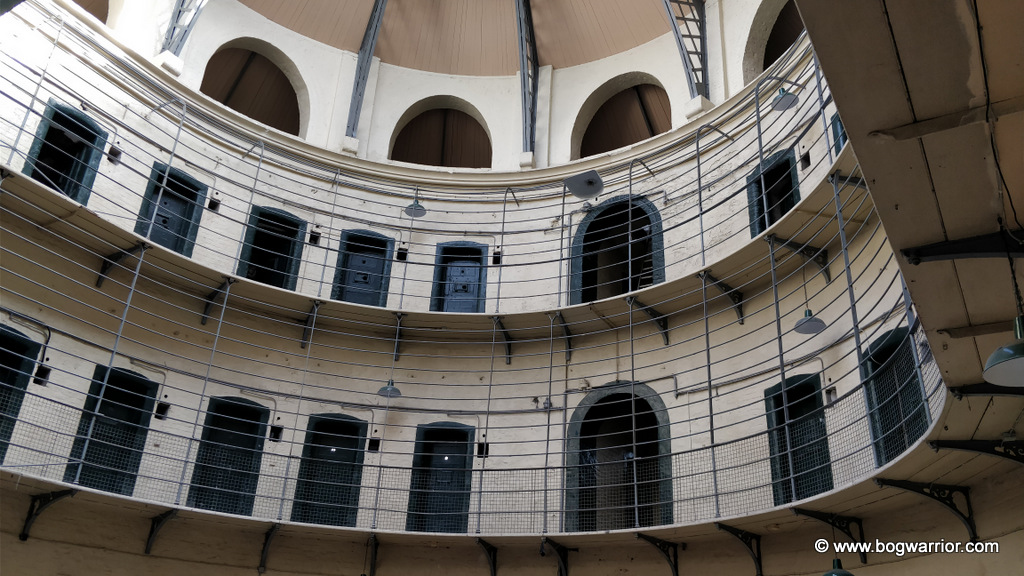
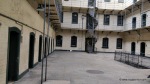
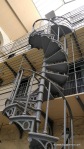
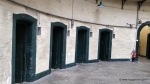
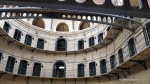
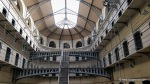
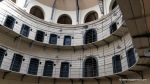
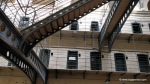
The best-known part of the prison is the East Wing. Completed in 1862, it was designed so that prison wardens would be able to keep an eye on a large number of prison cells at the same time. Not that it mattered because nobody ever escaped from Kilmainham Gaol without help from others. This part of the prison is stunning and it’s possible to walk into quite a few of the cells here. Film fans might recognise it from the likes of The Italian Job, Michael Collins, In the Name of the Father and er…Paddington 2.
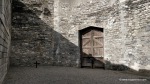
After that, we were taken outside to the exercise yard which of course hadn’t just been an enclosed area for prisoners to stretch their legs. A plaque on the wall marks the place at which four volunteers were harshly executed in 1922 by the Free State Army. One of them was a 19-year old called James Fisher who was arrested for having some guns. He wrote a letter to his mother on the eve of his execution and it’s a desperately sad read. It’s in the prison’s museum.
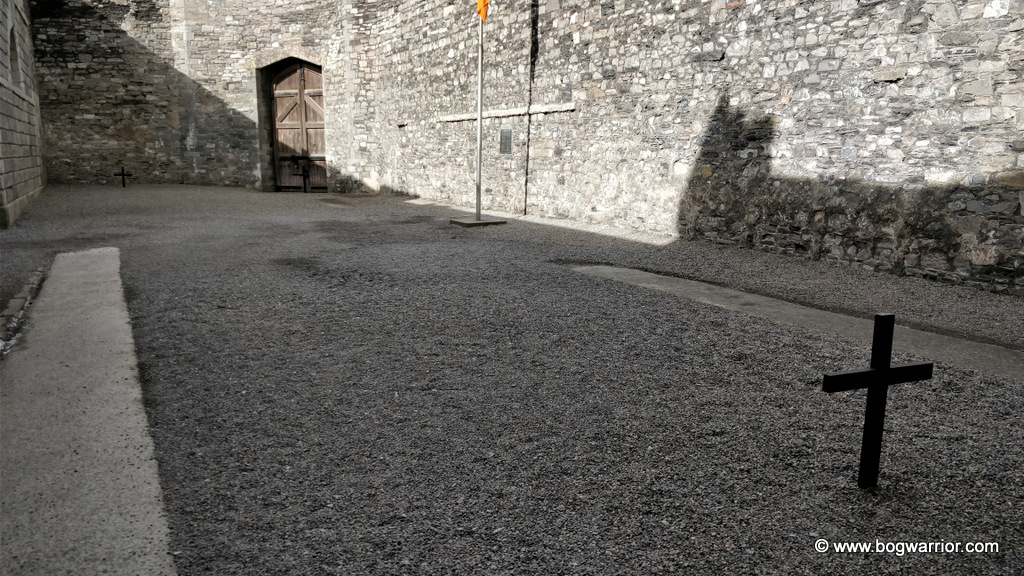
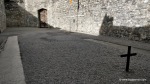
Onwards we went to the Stonebreaker’s Yard, where 14 of the leaders of the 1916 Easter Rising were shot. There’s a cross marking the spot where 13 of them stood and faced the firing squad. A second cross is located just inside the entrance gate. This is where the gravely ill James Connolly was taken from his hospital bed, strapped to a kitchen chair and shot on the spot. I’d heard that story numerous times down the years but when you see it all for yourself it really brings it home. And regardless of your politics, there is something sobering about standing in that relatively small yard, knowing that you’re following in the final footsteps of some iconic figures from Irish history.
Stonebreaker’s yard with both its crosses in view
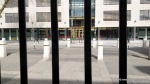
Finally, we were brought out to the front of the prison and the site where public hangings had once taken place. This served as a reminder that it wasn’t just Irish nationalists who never made it out of the prison alive. Lots of ordinary people were executed in this place too. And even though there’s now a Hilton Hotel across the road and the area has been gentrified, it’s not difficult to imagine what these people saw in their final moments.
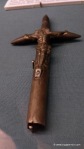
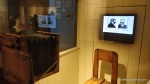
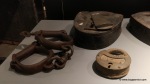
The prison museum was surprisingly good too. Somehow, seeing the possessions belonging to people whose names I knew from history class made them more real. Very mundane items such as glasses, a shoe, a scratched pocket watch, even a lock of hair. The arts and crafts created by bored prisoners banged up in prison are worth a look too. There’s something amusingly jarring about prisoners of war making pretty macramé bags or crucifixes from bullets. The Victorian era marked the start of the mugshot and there some of those original photos to be seen here.
What startled me the most were the photos of the prison before it was restored by the volunteers. Knowing how many buildings were lost in Dublin in the last few decades (don’t get me started!), it’s a minor miracle there’s anything there to visit now. Kilmainham Gaol might not be one of the happier places connected with Irish history but it is an important and very moving one. In short, it’s well worth visiting.
Tickets can be booked online from here. The visits are by guided tour only and places are limited on each tour. I strongly advise you to book in advance.
Gallery: Click on a Thumbnail to view
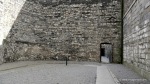
Exercise yard
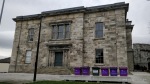
Kilmainham Courthouse and some funky purple bins
East Wing of the prison
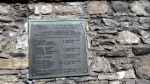
Plaque with the names and execution dates of Easter Rising leaders
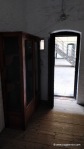
A view out onto the modern day street from the gaol
Cross made by a British Prisoner of War
19th-century courtroom in Kilmainham Courthouse
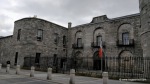
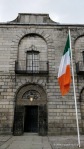
Exterior of the Gaol
Cross marking the spot where 13 of the leaders were shot
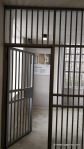
Some prison cell doorways
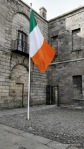
The Irish Tricolour outside Kilmainham Gaol
Interior of one of the cells
Mugshots from actual prisoners who were held here
East Wing of the prison
Rattle that Lock
The black cap judges used to don when sentencing defendants to death
Madonna mural, as painted by Grace Gifford. The widow of Joseph Mary Plunkett
The East Wing
Entrance into the old Gaol. Many people were hanged from the balcony above this
During my last trip to London, I only had time to make a brief visit to the Natural History Museum. To say it’s huge is an understatement and I would love to go back when I’ve more time to spare. It did get me thinking about our Irish equivalent, which is about as different to the one in London as you can imagine.
The museum as it is today, with the newer entrance
The Natural History Museum in Dublin was built in just under 18 months by the Royal Dublin Society. The foundation stone was laid in March 1856 and it opened to the public in August 1857. Unlike its London equivalent which is beautiful, huge, very striking and difficult to miss, this museum is almost unobtrusive. Tucked into a quiet leafy corner of Merrion Square, between Government buildings and the parliament, it’s easy to miss. It was originally built as an extension to Leinster House behind it (for the uninitiated, Leinster House is where the Irish Parliament sits) but that was changed in 1909. A new entrance was fitted to the opposite side of the building. Because it was so tricky to turn some of the exhibits around, some of the larger ones still face the original entrance.
The building before the new entrance was added
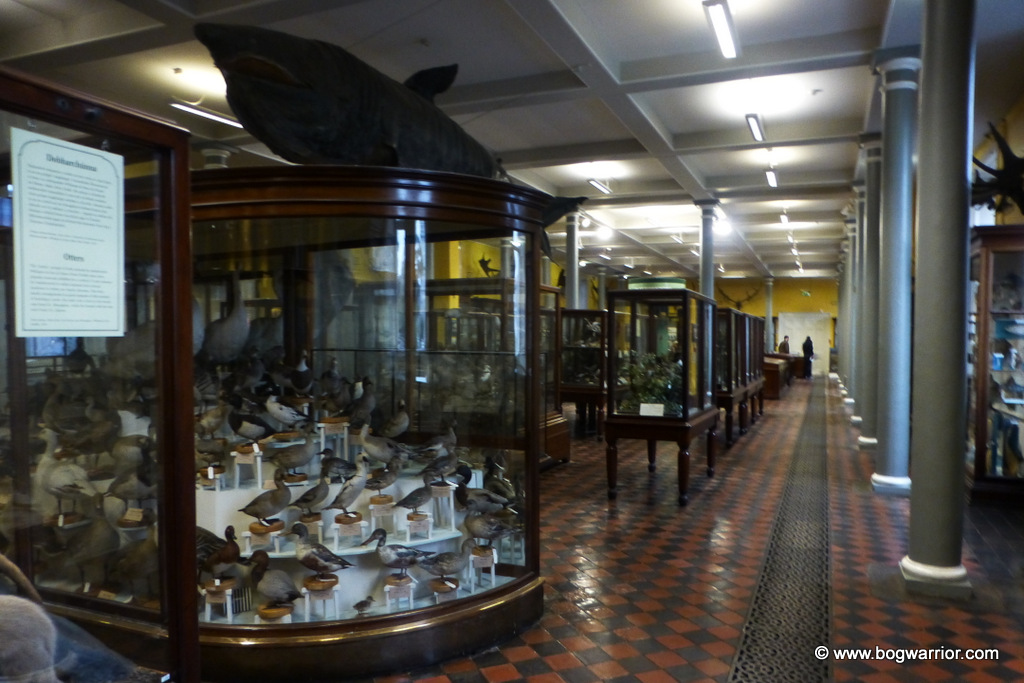
On its opening in 1857, the museum was treated to a lecture by the explorer David Livingstone (of “Dr. Livingstone I presume” fame) who gave a talk about his African adventures. If Mr Livingstone was to be brought back from the dead now, he would perhaps find that little has changed since then. Part of the charm of this museum is that it seems to be in a Victorian-era time warp. The glass cases are full of vintage specimens dating back to that era. There are also fossils of creatures which don’t live in Ireland any more – lemmings, lynxes, hyenas and even a brown bear. It is also very hard to miss the two 11,000 year old giant deer which face the entrance.
One of the giant deer
Sadly, the upper floors of the museum are no longer accessible. In 2010 the stairs collapsed and although they have been repaired, these upper floors are no longer open to the public. That means, annoyingly, that people can no longer look at the skeleton of a Dodo or the even rarer Solitaire. They can be viewed online through the virtual tours museum’s own website which is better than nothing, I suppose. But it’s still frustrating that so many things are in the building but cannot be seen. Worse still, because of budget cuts, many exhibits which were to be put on display have instead ended up in storage. Before the collapse of the Irish economy in the late 2000s, there were plans to build a museum in Collins Barracks which would have put some really interesting items on display for the first time. Sadly, the lack of money put paid to that and many items ended up in a warehouse instead. Hopefully, at some stage in the future this will change and we can get to see the sabre-toothed cat skeleton they’ve had in a box since 1910. Not to mention documents hand-written by Charles Darwin, moon rock, a dinosaur and a sea monster. Hopefully this will change in the future – as of February 2018 it was starting to look more hopeful
Click on a thumbnail to open the gallery
The museum as it is today, with the newer entrance
When driving during the week, I noticed a signpost for the tiny hamlet of Ahenny, Co. Tipperary. The sun was shining, I had time on my hands. And so, I took a detour to revisit the two high crosses which stand in the local cemetery. I last visited the site in March 2014 and it all looks rather bleak really. A July evening is much more forgiving, though the roads to the cemetery are still as hair-raising as ever 😀
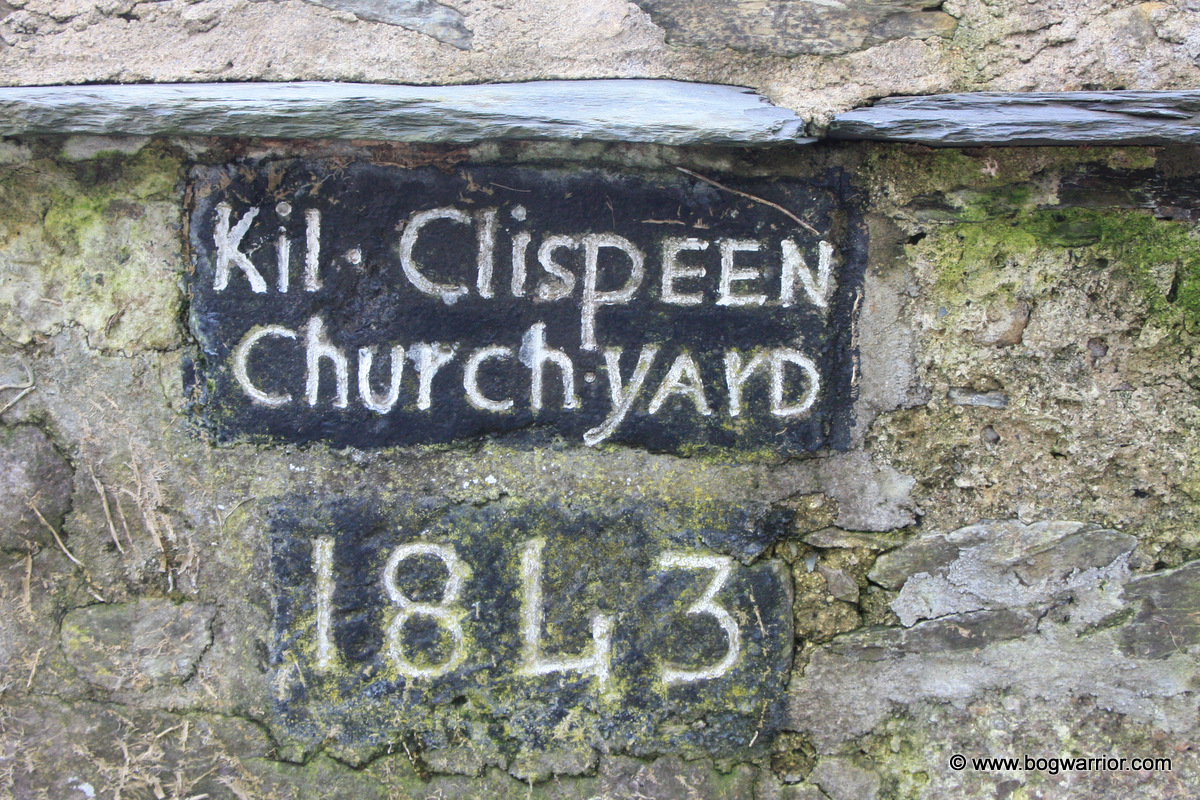
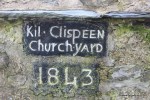
The two high crosses stand in Kilclispeen cemetery and are all that remains of a monastery which once stood here. Nothing appears to be known about the monastery which once stood on this site, apart from it possibly being attributed to someone called St. Crispin.
The two high crosses here are believed to be amongst the oldest in Ireland. Depending on what sources you read, they date from the 8th or 9th century. The interesting thing about these early high crosses is that they’re replicas of the original wood and metal crosses that would have been on the site. So as well as the usual decorative carvings, they replicate the rope and metal that would have bound the original crosses. Also visible on the front of these crosses are versions of the enamel or metal studs which would have decorated them. It is thought that the stone high crosses are larger versions of the original wooden ones which would have been in the monasteries originally. Of course, nobody can say for sure.
Once inside the cemetery, it’s easy to spot the two high crosses. They stand reasonably near each other in the centre of the cemetery without any other crosses near them. They’re both carved out of sandstone and stand over 3 metres in height. Although both have weathered, there is still a lot of detail to be seen on the crosses.
The South and North Crosses
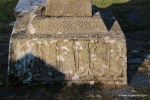
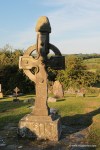
The North Cross is the smaller of the two. An unusual feature of this cross is that it has a capstone on the top. These don’t appear on many high crosses in Ireland. There are varying theories as to what it is and why it’s there. One suggestion is that it’s a replica of a Bishop’s Mitre whilst another archaeologist thinks it may not be an original feature at all. Apparently, it is removable but I certainly wasn’t going to test that out. Standing beside this cross, I didn’t even reach the arms. The cross is decorated with various patterns. Spirals, interlocking squares and even the odd animal’s head are the order of the day. On the base is what appears to be biblical scenes and the twelve apostles but it’s difficult to make out. It is a pity that it is missing one of its circular parts but it is still a fine cross.
The North Cross
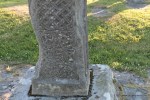
The South Cross doesn’t have the same conical cap as its compatriot but still, it is somewhat distinctive. Again, it is decorated with interlocking patterns, spirals, and Celtic style knotwork. The base of the cross is more badly worn than that of the North Cross.
The South Cross
The two Ahenny High Crosses are part of the Ossory group of high crosses. I plan to visit the other three that are part of this group. The two in Kilkieran and the high cross in Killamery.
I previously blogged about the century-old Plaster of Paris high cross replicas which went on display in Dublin. The mould makers chose the Ahenny high crosses as part of their original exhibition over a century ago. More recently, replicas of these two high crosses have found their way into Kilkenny’s Medieval Mile museum


 Height: 2.9m













 The Reverend Professor Nicholas Callan (1799-1864) invented the Induction Coil. For a number of reasons, including him being attached to a seminary rather than a scientific institution, his work was overlooked. He wasn’t given credit for its invention during his lifetime (its invention was attributed to Heinrich Ruhmkorff) but that has since changed. He also invented what became known as the “Maynooth Battery” which improved greatly on previous batteries that already existed. It was commercially successful and has been described as the Duracell of its time. Some of his batteries are on display, as is his induction coil and many other pieces of scientific equipment he created or worked with.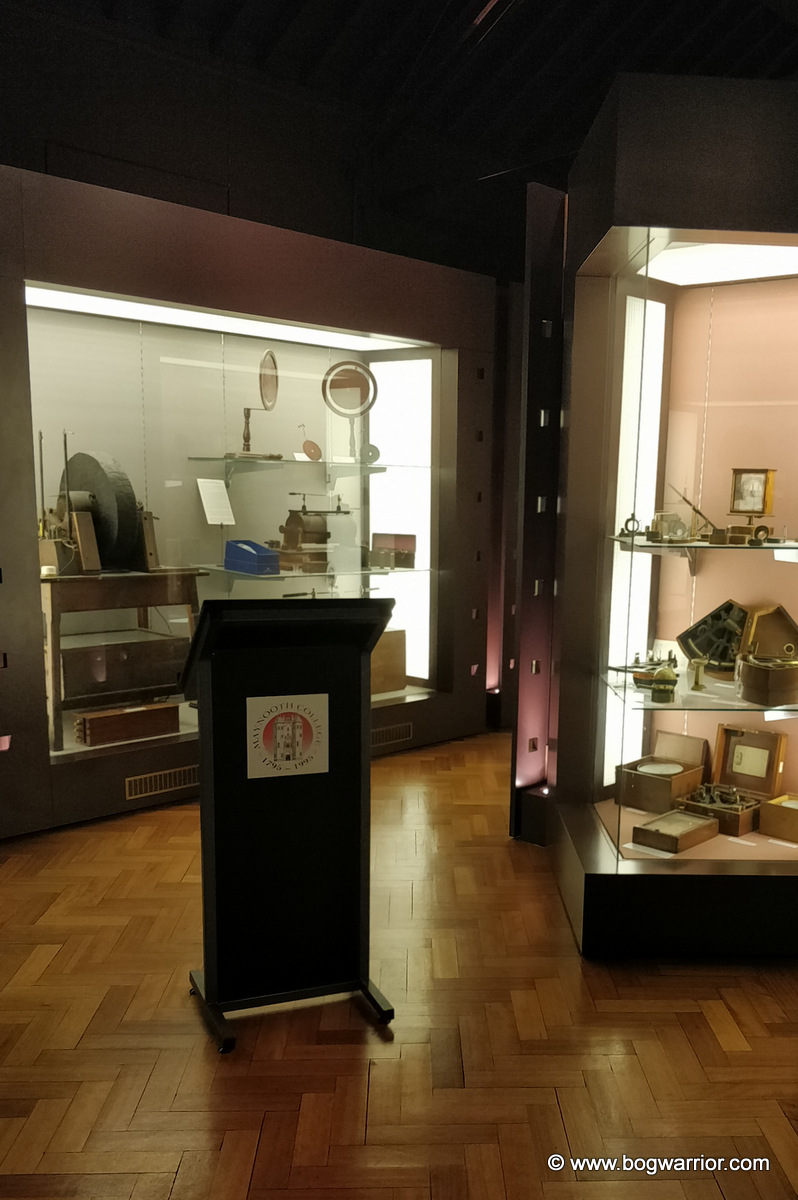





 The buildings in the fort were built at different times but look more uniform these days because of changes made to the site in the run-up to World War I. They were covered with roughcast and Tarmacadam was poured on the ground. This covered over the cobblestones which had been there. At least one archway was knocked so that tanks could be driven into the fort. Despite the alterations, there are still many older features remaining intact. The dry moat and sloping walls, circular lunette fortifications, tunnels and gun batteries being some of these.
 A caretaker’s house (locally known as Burke’s house, after the family who lived in it) was built in 1939 as part of the refortification. Unlike the other buildings here, its front door isn’t level with the ground but has steps up to its front door. This is because when they began to excavate the foundations, they found some human remains. It’s thought this is where a graveyard had been. It’s known that at one stage there was a church close by.
 Visitor Information















 Bogwarrior.com